Hello, and welcome back to The Best & The Brightest, your daily politics dispatch from Puck. I’m
Julia Ioffe and, because tomorrow is the first night of Passover, it’s foreign policy Tuesday.
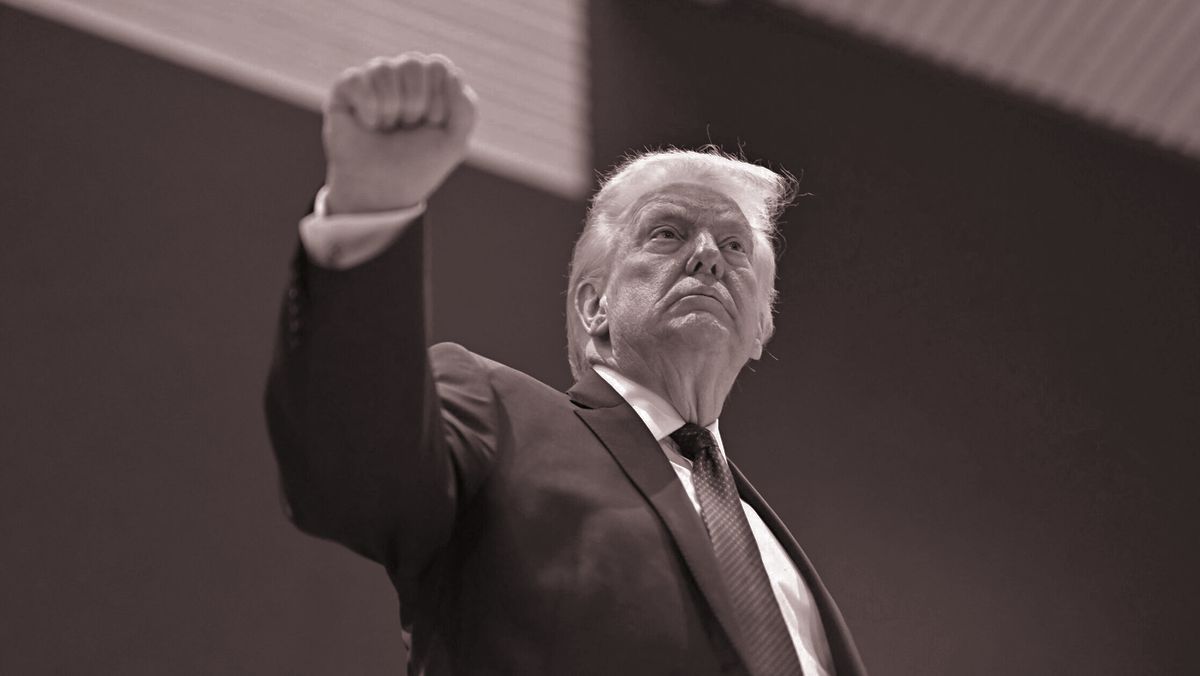
When Charlie Kirk was shot and killed in Utah last September, Trump and his allies were quick to point to antifa and the far left as the culprits. The president began to speak of “the enemy within,” and Stephen Miller
vowed to dismantle a “vast domestic terror network” of leftists and antifa. All of this raised quite reasonable fears that a president who vowed to be a dictator on day one was going to use Kirk’s assassination as a pretext to shut down domestic dissent. But gradually, those discussions receded from the headlines
because, well, [gestures around]. That doesn’t mean, however, that this administration has forgotten—or even stopped.
Tonight, an exclusive look into how the Trump administration is using the National Intelligence Priority Framework, a post-9/11 intelligence tool, as well as foreign terrorist designations, to get around the legal restrictions that are meant to protect Americans’ civil liberties and political speech. Or as one national security lawyer told me, “It’s trying to create a
structure and then dump people in there because you don’t like them.”
But first…
|
|
|
|
This muscle car business started with a single Facebook post.
Muscle Car Jr. connects 230,000+ car lovers across Facebook, Instagram and WhatsApp. That community helped its owner, Peter, turn a passion for restoring muscle cars into a thriving business.
Meta apps help over 35 million U.S. businesses, like Muscle Car Jr., grow.
Learn more.
|
|
|
|

|
Abby Livingston
|
|
The race to replace Nancy Pelosi is turning into a real contest, at least
according to one candidate’s recent internal polls. This week, Saikat Chakrabarti, A.O.C.’s former chief of staff, released a survey via Data for Progress that showed him placing second behind State Sen. Scott Weiner, with 20 percent support to Weiner’s 32. A third candidate, Connie Chan, who serves on the San Francisco Board of Supervisors, posted 17 percent support.
While Weiner’s margin looks healthy, he’s down five
points from a poll Chakrabarti’s camp released in January, while the other two have gained ground. (The latest survey included 800 English- and Chinese-speaking likely voters and had a 3 percent margin of error.) The top two finishers in California’s jungle primary on June 2 will face off in the general election, and serious campaign spending
could soon shake up the race… unless Pelosi decides to endorse, which might be an even more consequential factor.
|
|
|
|
And now for the main event...
|
|
|
|
Even as war rages across the Middle East, raising fears that Iran could activate sleeper
cells in the U.S. and Europe, the Trump administration is quietly working to designate antifa as a top counterterrorism priority—despite the protestations of experts who say this is a pretext for targeting domestic dissent.
|
|
|
|
Since 9/11, the U.S. intelligence community has relied on the National Intelligence Priorities Framework to
determine where its constituent agencies focus their attention and resources. The classified document tells the C.I.A. which organizations to infiltrate, the N.S.A. which signals intelligence to intercept, and the National Reconnaissance Office where to point its spy satellites. It’s historically included targets like Al Qaeda, ISIS, and the Taliban. But in recent months, according to three sources with direct knowledge of the conversations, the Trump administration has been
working to add a new top counterterrorism priority to the NIPF: antifa.
This has been a dramatic and alarming development for many counterterrorism veterans, especially given that “antifa” is not a coherent organization like Al Qaeda. The term has become a sort of MAGA catch-all for left-wing protesters—including domestically, where collecting intelligence on citizens is subject to a much stricter standard. The effort to shift focus to antifa has raised concerns among current and former
counterterrorism officials that the administration aims to turn an intelligence apparatus built to combat foreign threats against domestic political opponents. “They’re putting antifa on the list and bumping them up in the queue in a way that doesn’t correspond to threats,” one national security official told me. A recently retired counterterrorism official who was involved in the discussions confirmed this, saying, “The view from on high was that we had been ignoring this very dangerous threat
and we needed to devote resources to confirm that.” An administration official told me “it’s true” that the process of adding antifa to the NIPF has begun. (The State Department did not respond to a detailed list of questions in time for publication.)
Antifa has never been part of the NIPF before—and for good reason. The term, short for “anti-fascist,” has its origins in the (woefully unsuccessful) German and Italian anti-fascist movements of the early 1930s. These days, it is a vague and
mutable ideology, encompassing a broad range of far-left ideas—anarchism, communism, anti-capitalism—with no unified belief set. More importantly in the counterterrorism context, it’s not an actual organization with leaders, a command structure, or financing sources that can be targeted. What it is, however, is a central obsession of the second Trump administration.
|
|
|
|
Meta apps help over 35 million American businesses grow.
Muscle Car Jr. is one of them. From a single post, it’s grown into a community of over 230,000 car lovers on Facebook, Instagram and WhatsApp — and a thriving business.
“Restoring cars started as a hobby," says Peter, Muscle Car Jr.'s owner. "Now it's a full-time job."
See Peter's story.
|
|
|
|
This tension was on stark display in December, when Michael Glasheen, the F.B.I.’s
operations director for national security, testified in front of the House Homeland Security Committee that antifa is the bureau’s “primary concern right now” and “the most immediate, violent threat” domestically. But when questioned by Rep. Bennie Thompson, the committee’s top Democrat, about the location of antifa’s headquarters or how many members
it has, Glasheen was visibly flummoxed and could not answer.
The retired counterterrorism official acknowledged that there are people who engage in violence and call themselves antifa, but they’re “tiny groups of people that talk to each other online.” The official continued: “There’s no Comintern directing
them. There’s no centralized thing, and there’s certainly no centralized thing that provides instruction to other groups in the U.S., period.” As a former senior national security official put it, “They might as well be looking for Santa Claus.”
|
This isn’t the first time Trump has tried to go after antifa—though it may be the most consequential. In
September, following Charlie Kirk’s assassination, Trump issued an executive order labeling antifa a “domestic terrorist organization.” But there’s no such thing in American law: The First Amendment prevents the government from regulating ideology or association, which is among the reasons the
Biden administration never formally slapped the label on domestic right-wing extremist groups.
But the Trump administration appeared to find a work-around: going after extremist left-wing groups abroad, labeling them terrorist organizations, and then looking for connections to Americans. After all, the U.S. does have a legal mechanism to designate
foreign terrorist organizations (F.T.O.s), which, among other things, freezes their U.S. assets abroad and makes it illegal for anyone in the U.S. to provide “material support” to such a group. In the ISIS era, for instance, dozens of American citizens got caught up in F.B.I. sting operations on suspicion of this crime.
In November, the State Department
designated four far-left groups in Europe as foreign terrorist organizations: a German group called Antifa Ost, one Italian group, and two Greek groups. The notice billed them as violent anti-capitalist extremists bent on bringing down the Western world order. But the intelligence community’s own
assessments paint a far different picture. The Office of the Director of National Intelligence reports that “we have no information that Antifa Ost members have killed anyone or used firearms in their attacks,” including against a Budapest gathering of right-wing activists honoring the Nazi occupation of Hungary. (Instead, they used “fists, batons, hammers, and other blunt
instruments.”) The Italian group’s leaderless nature is right there in its name: the Informal Anarchist Federation. The two Greek groups, meanwhile, have detonated a couple of I.E.D.s and mail bombs at Greek government buildings but, according to the D.N.I., they typically alert the press “to minimize harm to bystanders.” One of the Greek groups has, per the same source, “at least 4-6 members, including a bombmaker.”
Yet they’re all now on the foreign terrorist organization list, alongside far larger and more serious groups like the Haqqani Network, Hezbollah, the Islamic Revolutionary Guard Corps, and Boko Haram. And as comical
as it might seem for the U.S. State Department to freeze the U.S. assets of four to six Greek anarchists—as if they have any—the action is in the fine print, which reminds people that it’s “a crime to knowingly provide material support or resources to those designated.” It also reminds Americans that “certain transactions or activities with those designated” can expose one to legal consequences.
Indeed, as soon as the four groups were designated, a memo went out to every U.S. embassy
requesting information about connections between these groups and American citizens, according to two sources familiar with the matter. This is standard procedure whenever a group is labeled an F.T.O.—designations immediately come with a warning for American citizens.
Many in the counterterrorism world are disturbed by what all this portends. “When we target these groups, we target networks,” said the national security official. “By having this very loose definition and making them a high
priority, it opens the door to targeting Americans.” Investigations can pull in people three or four degrees of separation from a target. That means an American attending an anti-Trump or anti-ICE protest in the U.S. might suddenly find that law enforcement has connected them to, say, an Italian eco-extremist. “You can charge anyone for material support,” the recently retired counterterrorism official told me. “If [left-leaning groups] are funding protests that, in their view, are terrorists,
then [the Trump administration] can go after them. It’s a slippery slope.”
|
|
|
|
In the meantime, Trump has started a war against Iran, the world’s leading state sponsor of terrorism. Within
the first week alone, there were two attacks in the U.S. that seemed inspired by the war, but experts warn the real hit is likely to come later, after Iran has taken time to plan an attack for maximum
impact—without warning the press in advance. Current and former counterterrorism officials warn that prioritizing antifa diverts resources from the real threats Americans face in the Middle East and at home. “While you’re running around chasing anarchist grad students in ski masks who are a minor annoyance at best,” the former counterterrorism official said, “you’re not focusing on the people who have the motivation and capacity to do real damage.”
|
Defenders of the policy say it’s nothing new, and it isn’t designed to go after Trump’s political opponents
at home. It’s simply leveling the playing field after what they believe the Biden administration did to right-wing groups. Biden did
issue America’s first “National Strategy for Countering Domestic Terrorism,” citing the right-wing insurrection on January 6, 2021, as a motivation. The ACLU, for one, praised the former administration’s “good intentions” but slammed its actual approach,
saying “it relies too heavily on law enforcement suspicion, investigation, and policing of beliefs rather than actual conduct—violence or attempted violence.” The Biden administration also designated two right-wing groups overseas as terrorist organizations, though it stopped short of adding them to the
State Department’s F.T.O. list.
Now that Republicans are in charge, however, they appear prepared to push the very policy they hated even further. “If we do to the left what the left did to us, then we should have the C.I.A. [go after] leftist groups,” the senior administration official told me, arguing that extreme left-wing ideology is just as dangerous as the right-leaning variety, if not more so. “I think it is about treating commensurate threats with commensurate seriousness,” this
person said. “These are terrorist thugs using political violence to squelch debate. Let’s see what parity would look like.”
There is a sense among Trump officials, according to two other sources familiar with internal conversations, that so-called experts only pooh-pooh the antifa threat because the U.S. government has never devoted the resources necessary to finding it. To that end, earlier this month the State Department sent a counterterrorism delegation to Germany, Greece, Italy, and
the U.K., where they asked their counterparts for cooperation on rooting out antifa elements. In the first three countries, they were met with confusion: Those governments were founded at the end of World War II with anti-fascism as a core ideology. And in the U.K.—as in Germany—the government is far more worried about the far right than it is about the far left.
Undeterred, the State Department is planning to send out another request for information to U.S. embassies, asking them to
collect information about left-wing extremists, apparently with the goal of finding more groups to designate as foreign terrorist organizations. The department is also organizing a July summit on the global antifa network and inviting representatives of foreign governments to participate. The goal, as one of the knowledgeable sources put it, is to “create a circle”—and the impression that antifa is a real problem that real government officials are taking really seriously. That said, according to
the second source with direct knowledge, “They’re having a hard time getting people to attend.”
|
That’s all from me this week, friends. Happy Passover to all those celebrating on Wednesday, happy Easter to
all those celebrating on Sunday, and I’ll see you back here next week. In the meantime, good night. And, for the sake of these beautiful spring holidays, let’s hope tomorrow is better.
Julia
|
|
|
|
Join Emmy Award-winning journalist Peter Hamby, along with the team of expert journalists at Puck, as they let you in on the
conversations insiders are having across the four corners of power in America: Wall Street, Washington, Silicon Valley, and Hollywood. Presented in partnership with Audacy, new episodes publish daily, Monday through Friday.
|
|
|
|
Unique and privileged insight into the private conversations taking place inside boardrooms and corner offices up and down Wall
Street, relayed by best-selling author, journalist, and former M&A senior banker William D. Cohan.
|
|
|
|
Need help? Review our
FAQ page or contact us for assistance. For brand partnerships, email ads@puck.news.
You received this email because you signed up to receive emails from Puck, or as part of your Puck account associated with . To stop receiving this newsletter and/or manage all your email preferences, click here.
|
Puck is published by Heat Media LLC. 107 Greenwich St., New York, NY 10006
|
|
|
|
|