Hello, and welcome back to The Best & The Brightest, your daily political dispatch from Puck. It’s
foreign policy Thursday, and I’m your host, Julia Ioffe, currently en route to the annual Munich Security Conference. I missed last year’s event because I was on maternity leave, so I didn’t get to hear J.D. Vance excoriate the Europeans for a litany of sins.
I’m also clearly out of practice, because I foolishly got a flight connecting through Frankfurt, forgetting that there’s
often some kind of airline strike the day before the conference, just when all the bigwigs are pulling into town. (I mean, why not use such a high-profile event, when the transatlantic political elite descends on Munich, for leverage?) This year was no exception. And so, hi from the train to Munich. It’s been a day.
Tonight, it’s been a crazy 48 hours on the Hill, with disagreements over D.H.S. reform and funding upending a CODEL to Munich, and members of Congress packing just in case. Now we know the House CODEL is not happening, but the Senate CODELs are. Still, some rogue House members are making the trip (more on who below), ostensibly with the goal of reassuring European allies. Will they? Can they? Plus, a look at the Munich Security
Conference as it was and will be. A year after Vance’s scolding, Europe is reckoning with a United States that is no longer a security guarantor, but a bona fide security threat.
|
|
|
Science fuels farmers ability to grow healthy, abundant food for Americans. That’s why companies like Bayer depend on
rigorous, predictable, science-based standards to bring new tools to market for farmers. Innovation isn’t a buzzword, it’s the lifeline that gives growers more options and keeps America’s food supply secure.
At Bayer, we succeed when farmers succeed.
Learn more.
|
|
|
Also mentioned in this issue: Nigel Farage, Marco Rubio,
the Glastonbury Festival, Jeffrey Epstein, the G7, Wolfgang Ischinger, Boris Johnson, Iraq, Masha Bucher, Chris Murphy, NATO, Alexander Stubb, Mark Warner, Davos, Alexandria Ocasio-Cortez, Donald Trump, the Department of Homeland Security, Thom
Tillis, Vladimir Putin, Greenland, John McCain, the E.U., Lindsey Graham, Sarah McBride, Ukraine, Mike Johnson, Jeanne Shaheen, and more…
|
- Wankers
of the world unite!: An American reader in London sent this photo of a “Visit America Today” ad on the Tube, promoting a fun trip to the United States—or so it would seem. On second glance, the ad is a gag, with A.I.-generated images of Donald Trump posing with Jeffrey Epstein and a young woman with her face redacted; young men wearing
swastika necklaces and marching with burning crosses; a child happily holding a machine gun in a classroom littered with the bodies of his classmates; and a grinning Greg Bovino in front of a little girl being detained by ICE agents.
The mock ad was created by Wankers of the World, a London-based satirical artist who’d
previously staged an installation around London and at the Glastonbury Festival, including one mocking the U.K.’s ruling class with images of scantily clad sex workers named “Nasty Nigel” (Farage) and “Posh Chubby Adult Baby” (Boris Johnson). The new ad hits a different nerve, underscoring how perceptions of the U.S. are changing all over the world, including in the
U.K., America’s closest ally. To wit, a new set of polling just dropped over at Politico showing that only 31 percent of Britons agree that the U.S. “shares our values” and 34 percent believe that the U.S. “protects democracy.”
- Masha
speaks: Last week, I wrote to you about Masha Bucher (née Drokova), the press secretary for the Kremlin-created Nashi youth movement who later moved to San Francisco, became a venture capitalist, and surfaced unexpectedly in the recently released Epstein files. In a long post on X (here’s the Russian
write-up of the locked post), Bucher offered an explanation: The Putin regime had disgusted and frightened her, she wrote, leading her to defect to the U.S., where she received her green card in 2017 (although she continued traveling to Russia
until 2021). Bucher said she had turned to Epstein for support, bamboozled by the many well-connected friends who had vouched for him. Now, of course, she’s embarrassed for ever having associated with him. When I reached Masha yesterday, she said her name should’ve been redacted, along with those of many other women whose identities the D.O.J. had disclosed without their consent. She declined to say more on the record and referred me to her Twitter post, which ended with a declaration of love
for America and the words, “Fuck Putin. Fuck Epstein.”
|
And now on to the main event…
|
|
|
The Munich Security Conference, once an annual affirmation of the U.S.-led transatlantic
order, has become a mirror for European anxieties that America is transforming from an ally to a threat—and that the task of protecting the continent will soon fall on their shoulders alone.
|
|
|
Once upon a time, the Munich Security Conference was a place where transatlantic decision-makers would gather
to talk about the issues of the day, which now seems quaint in retrospect. John McCain and Lindsey Graham would lead a CODEL to Munich, where they were received as grandees of the American empire along with whomever the White House chose to send. Whatever disagreements existed—over the invasion of Iraq, say, or how to handle a resurgent Russia—were not about the fundamentals of the alliance. Even after McCain died, even after Russia’s initial invasion of Ukraine
and the first Trump term, the foundational premise of Munich held firm: The American delegation was warmly welcomed as first among equals.
How times have changed. This year, Secretary of State Marco Rubio, once a senator himself, was originally supposed to lead a delegation of some 50 U.S. lawmakers, many of whom have taken it upon themselves to reassure the rattled Europeans that, after a year of the second Trump administration trashing the alliance—and
not ruling out using military force against Denmark—a significant sector of the American political establishment still values its European allies. (J.D. Vance, who stunned attendees last year by castigating Europe as a threat to the alliance, isn’t coming this year. “I mean, what’s he going to say?” said one attendee. “‘Fuck you again’?”)
But it’s currently unclear how many members of America’s now-largely self-neutered legislative branch will actually turn up.
Speaker Mike Johnson has barred the House CODEL to Munich in response to Democrats’ threat to withhold D.H.S. funds unless Republicans agree to reform ICE. John Thune, the Senate majority leader, has also suggested that lawmakers stay home until the standoff ends. As of Thursday morning, one House member told me they had packed just in case, but were waiting to see what would happen today. Another said they were planning to go regardless (on their own dime),
unless there were going to be votes on Capitol Hill this weekend. Alexandria Ocasio-Cortez, according to her rep, was also still planning to travel to Munich, where she is expected to give her first major overseas policy speech—an unambiguous signal of her national ambitions.
|
|
|
Science fuels farmers ability to grow healthy, abundant food for Americans. That’s why companies like Bayer depend on
rigorous, predictable, science-based standards to bring new tools to market for farmers. Innovation isn’t a buzzword, it’s the lifeline that gives growers more options and keeps America’s food supply secure.
At Bayer, we succeed when farmers succeed.
Learn more.
|
|
|
As of Thursday afternoon, there was some confusion over whether the Trump administration was itself trying to
shut the CODEL down. The Marine Corps sent letters to a number of congressional offices informing them that travel to Munich was canceled, according to some members of Congress, while other offices told me they’d received no such letter. One Democratic member told me that all this maneuvering was only partly about the optics of going abroad while D.H.S. funding remained in limbo. “I don’t think the administration wants us to go,” the member said. “I think they want the administration
officials to have the run of the place.”
The Senate is still planning for several CODEL groups to participate in the conference. In addition to the traditional Lindsey Graham contingent, there is a mini-CODEL consisting of Sens. Jeanne Shaheen, Thom Tillis, Chris Murphy, and Mark Kelly. Sen. Mark Warner, the ranking Democrat on the Intel Committee, is, as always, arriving unstaffed. But the House CODEL
appears to have dissolved. By late Thursday, as the 5:40 p.m. from Dulles was getting ready to depart for Munich, the group had been reduced to a few free radicals—including Democrats Jason Crow, Sara Jacobs, Yassamin Ansari, Sarah McBride, Jim Himes, and A.O.C.—going on their own.
The chaos is emblematic of the Trump 2.0 era, but it also stems from a darker set of choices confronting Congress. What’s
more important: reforming an immigration agency that shoots American citizens in the streets, or reassuring our closest allies that America is not, in fact, abandoning them? The United States, after all, is a superpower increasingly at war with itself—with its own citizens as well as with its own allies—while insisting this energetic self-destruction is, in fact, proof of newfound strength and resolve.
|
The organizers of the Munich Security Conference, meanwhile, are awaiting the American delegation as one
might the arrival of an erratic and potentially violent relative for Thanksgiving. The group’s annual report, normally a milquetoast snoozer, is a veritable banger this year. It’s called “Under Destruction” (get it?) and features an elephant on its cover—an allusion,
according to M.S.C. chairman Wolfgang Ischinger, to “the elephant in the room” that is the about-face of American foreign policy.
For one thing, the report’s authors seem to have taken to heart Vance’s admonition to stop silencing populist, right-wing voices. (Either that, or they’ve acknowledged the political reality that
these movements aren’t a passing fad.) They frame the rise of these movements as the result of “widespread disenchantment with the performance of democratic institutions and a pervasive loss of trust in meaningful reforms and political course corrections.” (In a survey the M.S.C. conducted ahead of this year’s conference, majorities in all
G7 countries said they do not believe their current government’s policies will make future generations better off.) “Both domestically and internationally, political structures are now perceived as overly bureaucratized and judicialized, impossible to reform and adapt to better serve the people’s needs,” the authors wrote. This disenchantment, they noted, has ushered in a new era of “wrecking-ball politics,” executed by “demolition men.” Chief among them, of course, is Donald Trump.
But
so far, the authors cautioned, we’re still in the demolition phase. No one has formulated a plan to replace the structures being dismantled—not the Trump administration, and certainly not Europe. Rather, the report suggested, what has emerged is a world in which the strong and wealthy can do whatever they want and get away with anything, “a world that privileges the rich and powerful, not those who have placed their hopes in wrecking-ball politics.” Caught between the American establishment’s
assurances and Trump’s “oscillating between reassurance, conditionality, and coercion,” Europe has been struggling to understand which is more real and enduring; which parts of the alliance are safe, and which have already been discarded.
|
|
|
In the process, both NATO and the E.U. have discovered just how vulnerable they are. In the east, Russia
continues to hammer Ukraine—its attacks having only grown more intense and frequent since Trump’s inauguration—while also stepping up its hybrid attacks across the continent, probing European airspace with drones and balloons. But Europe can also no longer find safety to its west, where the U.S., until quite recently, had refused to rule out using military force to wrest Greenland from Denmark. Meanwhile, the Trump administration continues to rage against European countries as freeloaders while
largely abandoning Ukraine—acting, as the report’s authors aptly note, as a disinterested mediator rather than an ally. “The era in which Europe could rely on the U.S. as an unquestioned security guarantor,” the report somberly concludes, “is over.”
|
Some
Corner of a Foreign Field
|
The sentiment that Europe needs to find its own way—and stop trying to appease a White House bent on
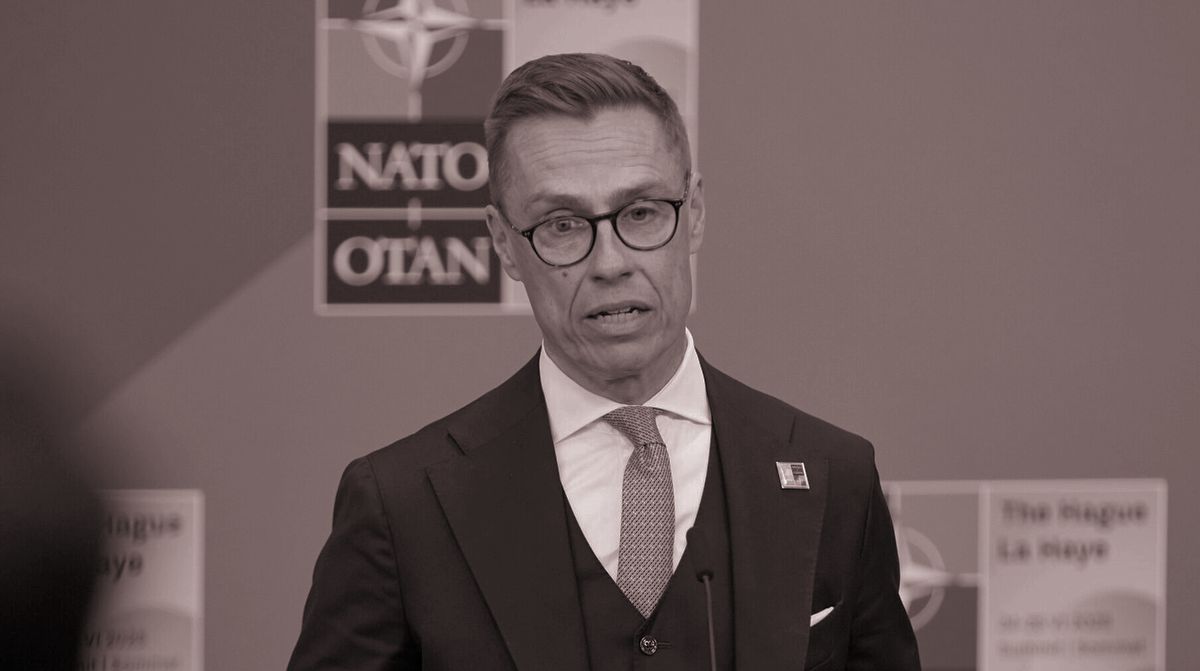
destroying the world order—has been spreading among America’s traditional allies. There was Canadian Prime Minister Mark Carney’s widely praised speech at Davos, saying essentially that Canada was done both with pretending America was still a close ally, and with playing the game of trying to mollify Donald Trump until he cycled into a new emotion. Finnish President Alexander Stubb struck a similar chord
speaking to his country’s parliament last week. “The foreign policy of the current U.S. administration is based on an ideology that contradicts our own values,” he said—a stunning admission from someone who has tried to present himself as a European Trump whisperer.
A year after
Vance’s vicious scolding, Europe has come to see the U.S. not as a security guarantor, but as a bona fide security threat. On the other side is Russia, which European intelligence agencies increasingly believe will attack NATO proper shortly after a ceasefire in Ukraine is reached—and win. And because NATO is bound by the collective and often fractious decision-making of its various supranational bodies, it is naturally slower and more cautious, drawing (justified) criticism that it still hasn’t ramped up production to meet the reality of the Russian threat.
As I write this on a train from Frankfurt to Munich, rolling through flooded fields on a grey
afternoon, I can’t help but feel the weight of European history bleeding into the present. We’ve already done this once. The gilded age to which Trump longs to return, marked by unfettered oligarchy and great-power competition, was also a tinderbox: a world wound so tightly that the shooting of an Austrian archduke set off a conflagration that soaked the continent in blood, inciting a catastrophically violent leftist revolution in Russia and a world war from which European demographics have
still not fully recovered.
In part, that’s because that world war soon led to another, deepening a demographic hole that forced Europe to turn to migrant labor for generations—a development that Vance and his fellow travelers now say is threatening Europe with civilizational erasure. But the people who lived through all that—who remember why America decided to build and bankroll a new world order, one in which its language is the world’s lingua franca and its
dollar the reserve currency of choice—are now mostly dead. And their descendants, intent on reading history upside down and backwards, are hell-bent on running the experiment one more time.
|
That’s all from me for now, friends. I’ll see you back here on Monday with a dispatch from the weekend’s
conference. Until then, good night. Tomorrow will be worse.
Julia
|
|
|
Join Emmy Award-winning journalist Peter Hamby, along with the team of expert journalists at Puck, as they let you in on the
conversations insiders are having across the four corners of power in America: Wall Street, Washington, Silicon Valley, and Hollywood. Presented in partnership with Audacy, new episodes publish daily, Monday through Friday.
|
|
|
Unique and privileged insight into the private conversations taking place inside boardrooms and corner offices up and down Wall
Street, relayed by best-selling author, journalist, and former M&A senior banker William D. Cohan.
|
|
|
Need help? Review our
FAQ page or contact us for assistance. For brand partnerships, email ads@puck.news.
You received this email because you signed up to receive emails from Puck, or as part of your Puck account associated with . To stop receiving this newsletter and/or manage all your email preferences, click here.
|
Puck is published by Heat Media LLC. 107 Greenwich St., New York, NY 10006
|
|
|
|