Hello and welcome back to The Best & The Brightest, your daily politics dispatch from Puck. It’s
foreign policy Thursday and I’m your host, Julia Ioffe.
Tonight, Jared Kushner, Steve Witkoff, and Dan Driscoll concluded yet another round of Ukraine negotiations in Abu Dhabi, where, once again, very little seems to have been accomplished. The delegations all said the meetings were productive, but what are they even talking about? Plus, up top: Epstein’s Russia connections, Pete Hegseth
vs. the Boy Scouts, and a eulogy for The Washington Post’s international reporting.
Also mentioned in this issue: Thorbjørn Jagland, Masha Drokova, Nellie Bowles, Bari Weiss, John Ratcliffe, Sean Parnell, Nilo Tabrizy, Lizzie Johnson, Francesca Ebel, Evan Gershkovich, Marco
Rubio, Stephen Miller, Dmitry Peskov, Volodymyr Zelensky, and many more…
|
- Epstein
overseas: The latest Epstein file drop is yet another reminder that the deceased pedophile had connections everywhere. Of course, Vladimir Putin is mentioned—it seems Epstein was on a fruitless quest to meet the Russian leader, like when he emailed former Norwegian Prime Minister Thorbjørn Jagland in 2013, saying: “I know you are going to meet putin on the 20th, He is desperate to engage western investment in his country...I have his solution.” But the real
surprise was Masha Drokova. In my Moscow correspondent days, we all knew her as the press secretary of the Kremlin youth group Nashi—a sort of state-created Turning Point USA—before she moved to San Francisco, reinvented herself as a tech entrepreneur, married an American, and took his name. (Her activities in Silicon Valley raised
suspicion that she was still working for the Kremlin, which she denied at the time.)
In the spring of 2017, a person whose name is redacted suggested that Epstein meet Drokova, whom they described as an “outstanding very successful for her young age lady who will be glad to meet you and show you her current plan to conquer the world.” A couple months
later, Drokova got in touch with Epstein and pitched him on her ideas to promote his brand, including by creating an “Epstein Prize” and a foundation to fight “women’s harassment.” She became a sort of publicist for Epstein
who, true to himself, asked her to send nudes. By the following summer, Drokova was proffering an introduction of her own, suggesting that Epstein meet then–New York Times tech reporter Nellie Bowles, future wife of Bari Weiss (whom Epstein later refers to, in an email to Bowles, as “your babe”). “I have a new friend who’s smart and fun,” Drokova wrote to Epstein of Bowles. “Let me know if you’d like to meet her. No agenda. Just for =un [sic]. I like her a lot.” (Drokova did not respond to a request for comment.)
- R.I.P. C.I.A. cheat sheet: For everyone who ever wrote an international relations paper in college, I have some sad news: After 64 years,
the C.I.A. World Factbook is no more. Originally published as an internal reference for American spies, the book—which contained reliable numbers on a given country’s population size, economy, natural resources, military, etcetera—soon became a go-to for other federal agencies. In 1997, the agency put it online, where it became a
solid informational touchpoint for the general population. John Ratcliffe had promised to get rid of programs that don’t advance what the Trump administration sees as the agency’s core mission, but this one will surely pull on a few wonky heartstrings in D.C.
- Scout’s
MAGA honor: Because all of America’s other foes have been vanquished, the Department of Defense has gone to war against the Boy Scouts. On Monday, Sean Parnell, Pete Hegseth’s press secretary and advisor, excoriated Scouting America, formerly known as the Boy Scouts of America, via a statement on X: “For more than a decade now, Scouting America’s
leadership has made decisions that run counter to the values of this administration and this Department of War, including an embrace of D.E.I. and other social justice, gender-fluid ideological stances. This is unacceptable.” The organization, Parnell went on, had to “return to core principles. Back to God and country—immediately!”
If the Scouts don’t comply, Parnell warned, the organization
risks losing the vital logistical support it gets from the National Guard for its quadrennial National Jamboree, attended by some 15,000 scouts, which is scheduled to take place this July in West Virginia. Neither Parnell nor Scouting America elaborated on the Pentagon’s demands—can you believe I’m writing this?—but Parnell
warned that “they are on the clock, and we are watching.”
Even though the demands aren’t public, it’s not hard to imagine what they might be. In the last decade, the organization lifted a ban on gay leaders, and allowed in girls and transgender children—which Hegseth, then a Fox News host, predicted would be the end of the group. Nor is it surprising that a secretary of
defense with ties to Christian nationalism might be interested in revamping how boys and young men are brought up in America. I can’t help but be reminded of the documentary Mr. Nobody Against Putin, which is nominated for an Oscar and portrays how the Kremlin militarized Russian
schools and intensified the indoctrination of children across the country.
- International news dies in broad daylight: On Wednesday, The Washington Post laid off most of its international reporters and editors. This included journalists like Nilo Tabrizy, who was doing the
hard work of identifying and verifying the victims of the Iranian regime’s massacre, and Lizzie Johnson, who was reporting from Kyiv even as Russian bombardments left large swaths of the country without power during the coldest days of the year. (It was so cold, Johnson
posted, that she wrote with pencil, because ink freezes.) Francesca Ebel, who continued reporting from Russia at great personal risk after her friend Evan Gershkovich was arrested, has also been laid off. Gone, too, is the entire Middle East team.
I am, of course, sad for friends and colleagues who have been covering the world for the
Post and for the American public. But I’m even more concerned about what this means for U.S. foreign policy. When I was based in Moscow, I heard often from policymakers—on the Hill, at the State Department and White House, in the intelligence community—that my reporting was vital to their work. They told me it helped them understand an otherwise inscrutable place about which they had to make high-stakes decisions.
But who in the U.S. government today needs that kind of knowledge
and expertise? If foreign policy nerds once complained that Biden’s “imperial N.S.C.” had sidelined the State Department, now the N.S.C. has joined State in irrelevance. Instead, it’s the presidency itself that’s imperial: There is one decision-maker, Donald Trump, and he is swayed by a coterie of courtiers, who push him toward regime change in Venezuela (Marco Rubio) and the military annexation of Greenland (Stephen Miller). Gone is the
interagency process and any pretense that regional expertise is necessary to diagnose or manage complex international issues.
Why else would Trump have put Steve Witkoff—who, by Trump’s own admission, knows nothing about Russia or Ukraine—in charge of negotiating an end to the war? What matters is loyalty to the boss. And Lord knows he’s not reading the international coverage—in any paper.
|
And now, the main event...
|
|
|
The latest Ukraine peace negotiations ended as they began, with merciless bombings, civilian
suffering, false promises from Russia and Europe, and a seemingly clueless American delegation.
|
|
|
A second day of negotiations to end Russia’s war against Ukraine wrapped up in Abu Dhabi today. Once again,
all sides praised the talks as constructive, but had little to show for them except a limited prisoner exchange—the first in five months. While the development is doubtless the most important moment of the war for those people’s families, it is not exactly the kind of diplomatic breakthrough that Trump has been looking for. In fact, Russia, characteristically,
asked for even more during this round than it had before. Now, instead of demanding de facto recognition of its control over the Donbas region, it wants international de jure recognition, including by the United States.
Heading into this week’s talks, Trump personally
beseeched Putin to stop Russia’s punishing bombing campaign on Ukraine’s civilian energy grid. The bombardment has
left millions of Ukrainians stranded in high-rise apartment towers with no electricity for the elevators—and, more importantly, no water or heat during the coldest winter of the war. Social media has been flooded with images of babies and the elderly struggling to stay warm in temperatures as low as –13 Fahrenheit; toddlers climbing seven flights of stairs in their snowsuits to a freezing
apartment; people trying to sleep in their cars, or in tents in the metro. In response to Trump’s request, Dmitry Peskov, Putin’s mustachioed spokesman, said that the Russian leader had agreed to halt the attacks and give the negotiations room to proceed.
It seemed like a promising start to the
talks. Except that it very quickly became another example of how these talks have always gone: Both sides are doing the bare minimum to make Trump think they’re helping him reach his goal, even as they misread each other on purpose or out of chronic mistrust. Volodymyr Zelensky hailed the partial ceasefire, which he said would last a week, starting January 30. The Kremlin countered that it would last until February 1, the date the talks were originally set to start—that is, two
days. (The talks were ultimately postponed because of tensions in the region over Iran.)
In any case, during the two days that Russia wasn’t bombing Ukraine’s energy grid, it was busy bombing other civilian targets, like a bus taking coal miners home at the end of a shift—an attack that killed at least 12 people. And by February 1, Russian drones and rockets were once again raining down on Ukrainian power plants that had already been badly damaged. The assault
coincided with the coldest days of the season, plunging thousands of apartment buildings in Ukraine’s two biggest cities back into freezing darkness.
The delegations that each side sent to Abu Dhabi, when negotiations finally started yesterday, reflected their well-earned mistrust. Some I spoke to in
Washington sounded hopeful because Russia had sent higher-level officials for this and the previous round of talks, which took place two weeks ago. Still, I couldn’t help but notice a little “fuck you” buried in the guest list. The Ukrainian delegation was led by Rustem Umerov, the former defense minister and head of Ukraine’s national security council, but it also included Kyrylo Budanov, Zelensky’s new chief of staff, who happens to be the (notoriously daring)
former head of Ukrainian military intelligence. In response, the Russian delegation was headed by Igor Kostyukov, the head of the G.R.U., Russia’s military intelligence, and the only senior military figure in the delegation whose name the Kremlin disclosed. The Russians have always been sticklers for protocol and reciprocity—and in their belief that there is no such thing as a former spy.
|
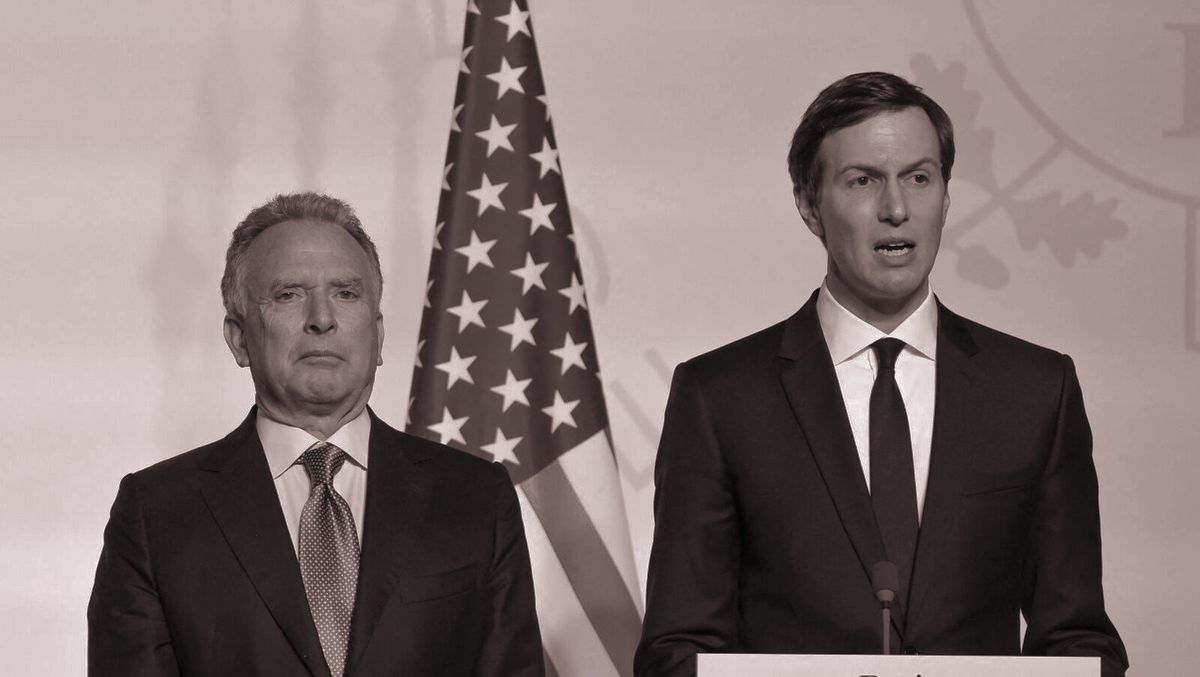
The Americans, meanwhile, were represented as usual by Jared Kushner, Steve
Witkoff, and Army Secretary Dan Driscoll. The Europeans, who have been trying to find a way into the negotiations, were absent. But on the eve of the talks, the Financial Times
reported that the Ukrainians and Europeans had agreed to a security guarantee in the event that Russia breached a future ceasefire (which,
given the history, seems inevitable).
It goes something like this: If Russia violates a ceasefire, within the first 24 hours, the Europeans give them a diplomatic warning, and the Ukrainian military does what it has to do to repel the attack. If the fighting continues beyond that, a “coalition of the willing” would step in, including some E.U. members, along with Turkey, Norway,
the U.K., and Iceland. Should the hostilities continue for 72 hours past the initial violation, “a co-ordinated military response by a western-backed force involving the US military would take effect,” according to the FT.
This seems like major progress, but as always, “seems” is the operative word. Like the negotiations as a whole, the security agreement is an elaborate performance by all sides, a simulacrum of negotiating for peace where none is actually on offer. On one side
are Ukraine’s ostensible allies, making promises on which they know they won’t deliver, not least because any guarantee strong enough to satisfy Ukraine would be unacceptable to Russia. The Kremlin has already made clear that foreign boots on Ukrainian soil (other than Russian ones, of course) are a nonstarter.
The Russians, meanwhile, seem to be the most clear-eyed. After the first day of negotiations, Peskov
vowed that they’d keep fighting to achieve their maximalist demands: Why settle diplomatically when you’re winning militarily? Granted, they’ve not been able to achieve most of their military goals, and their economy is slowly
sinking into the mud of this pointless war. Russian social media is flooded with people broadcasting sticker shock at the grocery stores, where prices rose sharply last month, while Putin
announced this week that the Russian economy grew by 1 percent last year—which means the real number is much, much lower. Still, it is abundantly clear that Putin will continue to tank the economy to try to get what he thinks he’s owed in Ukraine.
And yet, at the end of every summit or meeting or phone
call, the participants declare that they have agreed on everything excepting a couple small points, like land and security guarantees—as if those aren’t the crux of the whole damn thing. Then they arrange the next round of talks, continuing the charade, all for an audience of one.
|
That’s all from me, friends. I’ll see you back here next week. Until then, good night. Tomorrow will be
worse.
Julia
|
|
|
Join Emmy Award-winning journalist Peter Hamby, along with the team of expert journalists at Puck, as they let you in on the
conversations insiders are having across the four corners of power in America: Wall Street, Washington, Silicon Valley, and Hollywood. Presented in partnership with Audacy, new episodes publish daily, Monday through Friday.
|
|
|
The industry’s go-to source for unflinching reporting on the trillion-dollar business of artificial intelligence - perhaps the
single most important technology of our time. Ian Krietzberg, the powerhouse journalist behind The Deep View, delivers twice-weekly insights into the latest dealmaking and breakthroughs in A.I., and how the intersecting worlds of finance, entertainment, media, and politics are being transformed in its wake.
|
|
|
Need help? Review our
FAQ page or contact us for assistance. For brand partnerships, email ads@puck.news.
You received this email because you signed up to receive emails from Puck, or as part of your Puck account associated with . To stop receiving this newsletter and/or manage all your email preferences, click here.
|
Puck is published by Heat Media LLC. 107 Greenwich St., New York, NY 10006
|
|
|
|