|
Julia Ioffe
|
|
Hello, and welcome back to The Best & The Brightest, your daily political dispatch from Puck. It’s
foreign policy Thursday, and I’m Julia Ioffe.
Tonight, we’ll meet Erin Elmore, a Trump campaign surrogate who runs an obscure office in the State Department. This weekend, she’s taking a break from deciding what art the U.S. government puts in its embassies and consulates to marry her fiancé, Dan Scavino. Then it’s back to fighting the MAGA culture wars abroad and trying to get the American exhibit at the Venice Biennale off the ground.
Mentioned in this issue: Erin Elmore, Lew Olowski, Stephen Miller, Anna Paulina Luna, Dan Scavino, Kathleen Kavalec, Tilman Fertitta, Richard “Cheech”
Marin, Steve Penley, J.D. Vance, Alma Allen, Jeffrey Uslip, Jenni Parido, Katie McGinty, Pat Toomey, Lara Trump, Elon Musk, Jesse Watters, Brian Mast, Tim Burchett, and many more…
But first…
|
- The
Big Olowski is back!: For those who have been following the strange saga of Lew Olowski, the State Department’s MAGA, Monster Energy drink–swilling, erstwhile head of H.R., there’s an update. Back in December, Olowski apparently had an
epic meltdown at a party when a position he had been promised, running the Office of Foreign Missions, was yanked back. (The State Department disputed this account at the time.) Someone even suggested calling diplomatic security, but Olowski, according to sources familiar with the incident, walked himself out of the building and then went on an extended leave.
Staties everywhere
circulated jubilant memes, and even an A.I.-generated rap song. Olowski, who had become the eager face of mass layoffs of American diplomats, had seemingly gotten his just deserts. This week, however, Olowski reappeared at main State, as if by magic. His official State Department bio says he is now head of O.F.M., as the “senior bureau official,” a bureaucratic sleight of hand that would allow him to bypass Senate confirmation. How did this happen? Crestfallen Staties don’t know, but
speculate that his long-rumored connection to Stephen Miller has finally paid off. (The State Department declined to comment on the record.)
|
And now for the main event...
|
|
|
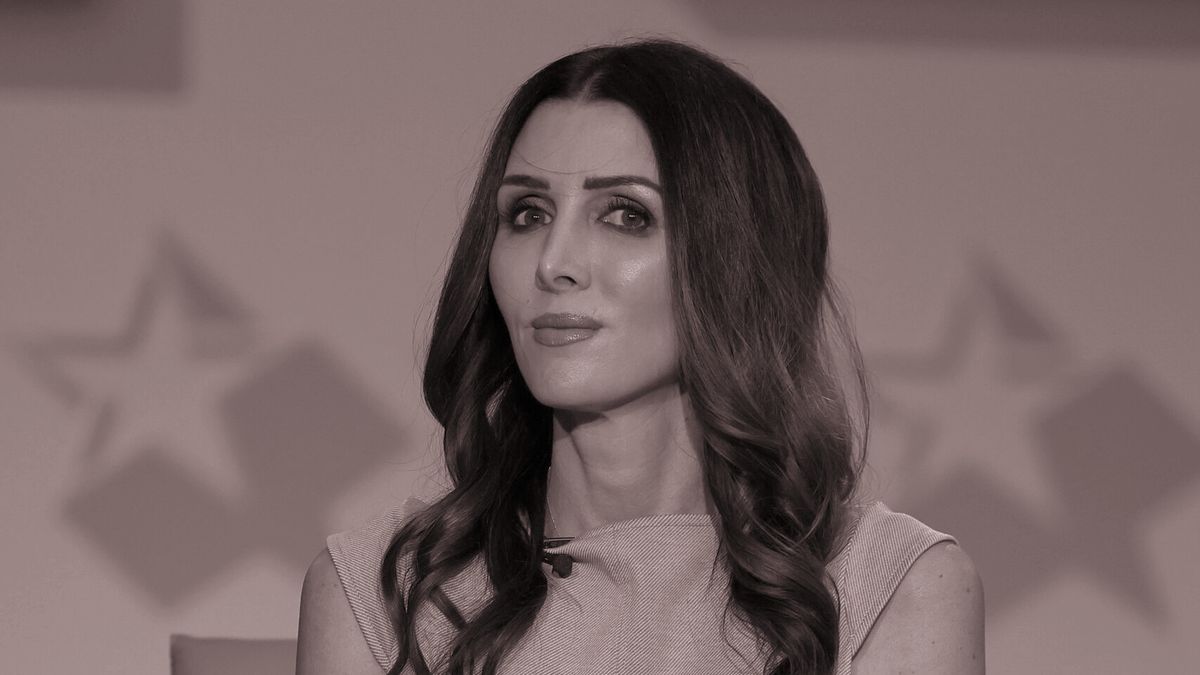
Erin Elmore, the former Apprentice contestant now running the Art in Embassies
program, has transformed her vanity appointment—and close relationship with the Trumps—into a political weapon, defenestrating ambassadors and threatening to primary anyone who gets in her way.
|
|
|
|
|
Julia Ioffe
|
|
|
|
On the evening of April 15, 2025, Erin Elmore, a Trump appointee who runs
the Art in Embassies program at the State Department, received a frantic call. Florida Rep. Anna Paulina Luna, a conspiracy theorist who has talked extensively about her belief in aliens, had just arrived in Romania on a CODEL, and she was shocked by what she had seen: “satanic baby art” on the walls of the American ambassador’s residence in Bucharest.
Elmore did not elaborate on what Luna meant by “satanic baby art,” but it didn’t matter. Elmore was on
it. “Within 15 minutes, I was on the phone with Marco [Rubio]’s team, not only having the art removed from Art in Embassies, having the art removed from the State Department, out of everything,” Elmore said last week on Katie Miller’s podcast. “Oh, and by the way, that ambassador?” Elmore
added theatrically. “She’s no longer with us.”
|
|
|
SPONSORED BY: COALITION TO STRENGTHEN AMERICA'S HEALTHCARE
|
Behind many dangerous delays in care are insurer practices that prioritize administrative hurdles over patients. Excessive prior
authorization requirements and AI-assisted coverage denials pull clinicians away from the bedside and bury care decisions in paperwork. While hospitals work around the clock to deliver timely, life-saving treatment, insurer delays and denials slow access, disrupt clinical judgment, and increase costs. When approvals take days or weeks, patients wait longer for critical care, conditions worsen, and risks rise, putting paperwork and process ahead of the care patients urgently need.
|
|
|
It was a remarkable claim from a woman whose job, at least on paper, is a vanity post—a
soft-power position in an administration ostentatiously dedicated to the hard and loud variety. But Elmore perfectly embodies how influence is wielded and expressed in the second Trump administration. Sitting next to her on The Katie Miller Podcast was White House deputy chief of staff and director of the presidential personnel office
Dan Scavino, who also happens to be her fiancé. (The two are getting married this weekend at Mar-a-Lago.) And though Elmore’s career path from a reality TV contestant to State Department official is hardly an anomaly in MAGAland, it’s especially revealing of how this administration purports to run the
world—and whom it selects to do so.
In the couple’s interview with Miller, Elmore went on to claim that another unnamed ambassador had wanted “‘very fine people’ Charlottesville art.” He too, she said, was also “no longer with us.” (She quickly clarified that both ambassadors were “with us in the world,” just no longer at their posts.) “It’s all true,” said Scavino, smirking that “some folks” overseas “are just not aligned with the president.” Elmore cut in. “We all serve at the pleasure
of the president,” she said, pointedly. “Even Biden’s ambassadors.”
The U.S. ambassador to Romania at the time was Kathleen Kavalec, a career foreign service officer. Nominated for the role by President Biden in 2022, Kavalec was a specialist in Russian and European affairs—not
contemporary art. The “satanic” artwork in question, Faun in the Big City, an L.E.D. lightbox with a big horned head in the center and baby heads around it, is admittedly somewhat creepy. But it had been chosen by the Art in
Embassies program, not Kavalec herself. (Ellen Susman was the director of the program from 2013 until early in Biden’s first term, when Megan Beyer was appointed as her successor.)
Regardless of who chose it, the morning after the reception, Kavalec received an email instructing her to take the piece down. Two days later, just over two years after assuming the post and three days after Luna placed her urgent call to Elmore, Kavalec was told to pack her
bags. The Romanian press, which speculated that this was Trump feeding a scalp to the local right-wing party, quoted an American government representative as saying that Kavalec had “reached retirement age and chose to retire. It has nothing to do with politics.” But, as Elmore boasted on Miller’s podcast, it absolutely did. “I’m a little bit of
an undercover person in the State Department,” she confessed on Miller’s podcast. “[I] can get people out through art, shockingly.”
The State Department declined to make Elmore available for an interview. Principal Deputy Spokesperson Tommy Pigott responded to a list of detailed questions by calling them “bad faith” and “full of inaccuracies.” Kavalec, on the other hand, was surprised to learn that it was the art that got her fired. “I proudly served my country for 40 years as a career U.S. diplomat, under both Republican and Democratic administrations, starting with President
Reagan,” she said in an emailed statement. “I was honored to display the dozen or so works of American artwork from the State Department’s Art in Embassies program during my time as U.S. ambassador to Romania,” adding that the U.S. has “no better ally in Europe than Romania.”
“The current administration appears not to believe in the America I grew up in,” she went on. “One that celebrates, rather than demonizes, its immigrant heritage.”
|
In December 2024, according to Elmore and Scavino, Trump offered Elmore “a very big job,” but Elmore said she
turned it down. She has a 12-year-old son, she told Miller, and she didn’t want to be away from him. Elmore lives in Jupiter, near Trump’s golf club and a half-hour drive north of Mar-a-Lago, which is the locus of her very busy, very MAGA social life. (Elmore’s vanity license plate reads “EW LIBS.” ) Instead, she took the job atop Art in Embassies at State, which, she told Miller,
allows her to work “from anywhere in the world.”
The program, created during J.F.K.’s presidency, oversees the art displayed in U.S. diplomatic properties around the world—embassies, consulates, ambassadors’ residences. By statute, a tiny portion of the budget to build an American embassy or consulate has to go to the art installed inside. The director, traditionally a political appointee, is supposed to help curate the selection, drawing from the department’s own art
collection and curators, or working with artists and ambassadors to create something site-specific. Tilman Fertitta, Trump’s ambassador to Italy and the owner of the Houston Rockets, borrowed heavily from the Houston Fine Arts Museum, showing off his hometown’s collection, to dress up his official residence in
Rome. Kavalec’s ill-fated exhibit was centered on her birthplace, near San Diego and the Mexican border, and was intended to showcase the region’s cultural richness. (The artworks were on loan from the Chicano art collection of Richard Marin, better known as “Cheech,” which is now on display at the Riverside Art Museum in
Riverside, California.)
|
|
|
SPONSORED BY: COALITION TO STRENGTHEN AMERICA'S HEALTHCARE
|
When access to care depends on administrative approval, patients pay the price. Excessive prior authorization requirements and AI-assisted
coverage denials delay treatment and shift decisions away from doctors and toward paperwork. These insurer-driven practices add an estimated $83 billion in administrative costs alone. While hospitals work to deliver timely, affordable care, administrative barriers slow treatment, increase risk, drive up costs, and undermine trust—especially when care is time-sensitive and patients need medical decisions guided by clinical judgment, not process.
|
|
|
The Art in Embassies program also oversees the selection and installation of the art in the American pavilion
at the Venice Biennale. Given this remit, Elmore is effectively running the international arm of Trump’s literal culture war. “Like he’s done with the performing arts at the Kennedy Center, [the president] wanted to make sure that I was here, to make sure that our visual arts were not woke, were not dominated by people who have a leftist ideology,” Elmore told Miller. In the summer of 2025, for instance, her office sent
an exhibit by Steve Penley—all swimmy giclée prints of American flags and portraits of Trump and Reagan—to Brussels, the seat of NATO and the European Union. It was a sort of middle finger to institutions loathed by the MAGA core and Vice President J.D. Vance. (Penley,
dubbed “the da Vinci of the G.O.P.,” has been MAGA’s go-to painter since 2015.)
Meanwhile, the selection of an artist for this year’s Biennale has been an
organizational disaster. The Trump State Department has sidelined the National Endowment for the Arts, which has traditionally played a leading role in picking the artist to represent the U.S. from a pool of applicants. Instead, State used an opaque process to
select Alma Allen, a little-known Utah-born sculptor who is, ironically enough, currently based in Mexico. The exhibit, titled Call Me the Breeze, is curated by
Jeffrey Uslip, a controversial figure who resigned as chief curator of the Contemporary Art Museum of St. Louis after his very first exhibition went sideways. That show, by artist Kelley Walker, a white man, took images of police brutality against Black people and splattered them with chocolate and toothpaste, but neither he
nor Uslip were able to explain to perplexed and offended viewers what the work was actually trying to express.
The State Department traditionally covers only a small sliver of the massive cost to bankroll the Biennale exposition—it involves millions in shipping, installation, and insurance costs—and the difference is generally made up by known and trusted nonprofits, like the Ford Foundation, which have the experience to handle such a complex financial and organizational feat. This year,
however, all of that is out the window. To make up for the gap in funding, Elmore enlisted her friend Jenni Parido, a Florida socialite who is completely unknown in the art world. (She ran
a pet-food company in Florida, where she and Elmore circulated on the same philanthropic gala circuit.) Parido, in turn, quickly created the American Art Conservancy, which became a 501(c)3 in June 2025, and is now actively
soliciting donations. Because it is so new, there is no publicly available information on its donors, and Parido did not respond to a request for comment.
|
A Match Made in MAGA Heaven
|
Elmore, like many of the women in Trump’s orbit, got her start on reality TV. A young attorney with a law
degree from Villanova, she met Trump when she was on Season 3 of The Apprentice, back in 2005. She was eventually “fired,” but remained a Trump acolyte, even as she went on to other gigs, like hosting at QVC, the 24/7 shopping network. When Trump ran for the White House in 2016, Elmore was fully on board as a campaign surrogate, though she and her then-husband, fellow Philadelphia
native Craig Spitzer, hosted a fundraiser for Democratic Senate candidate Katie McGinty that year. (Elmore justified this apparent act of bipartisanship by noting that Pat Toomey, the Republican candidate, hadn’t yet endorsed Trump. “What does that say about him?” she said at the
time.)
Eventually, Spitzer and Elmore migrated south to Jupiter and joined Mar-a-Lago, where they became regulars on the gala circuit. Elmore befriended Lara Trump, Eric’s wife and Trump’s daughter-in-law, bonding with her over politics and their mutual love of dogs. Elmore and Lara hosted the ritzy
annual gala for the Big Dog Ranch Rescue, where the president regularly makes an appearance. Last year, he and Elon Musk helped
the charity raise over $4 million. During the 2024 campaign, Elmore joined Lara on the trail, donning her team’s pink “Women for Trump” jackets as they crisscrossed the country. (They dubbed themselves the “MAGA
Barbies.”)
Shortly after Trump’s reelection, a freshly divorced Elmore went on Jesse Watters’ Fox News show—“He’s my favorite,” she said, “we’re both from Philly.” After she finished the hit, she noticed a Twitter D.M. from Scavino, a fellow divorcé. He congratulated her on a job well done. “Great messaging,” Scavino recalled writing. Elmore, flattered by the
attention of such a high-ranking Trump lieutenant, found a way to keep the conversation going. (“I slid into her D.M.s, but it wasn’t with the intention [of starting something romantic],” Scavino recalled.) Scavino mentioned he was going to move close to Mar-a-Lago for the transition, and Elmore offered to show him the area. They met for a drink, it lasted three hours, and the rest is
history.
In September, after securing Trump’s blessing, Scavino got down on one knee in the Rose Garden and proposed. The White House digital team quickly turned the moment into a slick reel that Scavino blasted out to his 2.2 million Twitter followers. It was a match made in MAGA heaven.
|
“The Rules Don’t Apply to Us”
|
Elmore arrived at State just a couple days into the new administration, her paperwork having arrived from the
White House in record time. “That’s how I knew she had a lot of juice,” one former official who worked with Elmore told me. Elmore, in fact, made sure everyone knew this. While the Trump administration made federal employees return to the office and scrap teleworking arrangements, she was openly flying home for long weekends to Florida on Air Force One with the president, often telecommuting from Jupiter to be with her son—a budding golf talent, she told people in the department.
|
|
|
The rules that applied to State Department employees, Elmore made clear, were not for her—a friend of the
president’s daughter-in-law and girlfriend to his right-hand man, not some woke Deep State dweeb. “Two months into the job, she wrote me an email that said, basically, I decided that I don’t attend meetings with you or report to you. I report to the White House,” a former State Department official recalled. Last spring, when the department was in the throes of Rubio’s re-org, Elmore chimed in during a meeting on how to navigate the changes. “Well, the rules don’t apply to us,” she said, according to someone in the meeting, meaning political appointees. “She did whatever she wanted,” the first former official recalled.
Elmore isn’t modest about her MAGA politics either. The former State Department official who worked with Elmore recalled how, during a discussion about a Republican on the Hill holding up funding for
a State art project, Elmore interjected, “Let’s primary them!” (“My response was, ‘Oh my god, this woman is a lunatic!’” the former official told me.) The second former official also told me that Elmore spoke of primarying Art in Embassies’ Republican opponents on the Hill.
Sadly for Elmore, she has many such opponents on the right, who don’t see the value in spending taxpayer dollars on paintings that would only be seen abroad. Could anything sound more like a liberal, elitist
boondoggle? Nevertheless, when Elmore wasn’t threatening primaries, she would head up to the Hill for a charm campaign. Before going, she’d wave off her team’s regular briefings on the Hill, claiming she already knew these members of Congress.
But she didn’t always have the influence she thought she had. “One time,” recalled the official who worked with Elmore, “she got her ass handed to her.” Elmore had gone to talk to Rep. Brian Mast, who represents Jupiter in Congress,
but who wouldn’t support funding for her program—and refused to budge even after she met with him. “She was so upset,” recalled the official, who had to calm Elmore down and convince her it wasn’t personal. Another time, Elmore tried to sway Rep. Tim Burchett, of Tennessee, a longtime opponent of
Art in Embassies. But the staffer she encountered had no idea who she was—until they called the State Department to ask. (Neither congressman responded to requests for comment.)
Like many MAGA arrivistes in Washington, the accumulation of slights seems only to have fueled Elmore’s desire to humble every D.C. insider who has disrespected her. Once, Elmore asked for a Microsoft Teams link to join a meeting remotely. After being told there was no link because it was an in-person meeting, she
walked in—she’d been in the building the whole time—and demanded to know why she wasn’t told the meeting was in person. “Someone said, ‘Well, if you’re in the building, all the meetings are in person,’” the former State Department official recalled. Afterward, the official said, Elmore asked what post that person held. When she got her answer, she shot back, “Not for long!” the former official recalled. “That was the vibe she gave most of the time. She would smile at you while letting you know
that she is well-connected, and could exact retribution if she so chose.”
In the end, the career State Department employees who were tasked with working for her didn’t know whether she was actually able to do anything with the wasta she flaunted so brazenly. She had completely cut them out of the process. “I don’t know if she talked to the president,” the official who worked with her told me. “She didn’t tell us anything. I don’t know if she was making side deals, I have no idea.”
|
That’s all from me, friends. I’ll see you back here next week. Until then, good night. Tomorrow will be
worse.
Julia
|
|
|
Need help? Review our
FAQ page or contact us for assistance. For brand partnerships, email ads@puck.news.
You received this email because you signed up to receive emails from Puck, or as part of your Puck account associated with . To stop receiving this newsletter and/or manage all your email preferences, click here.
|
Puck is published by Heat Media LLC. 107 Greenwich St., New York, NY 10006
|
|
|
|