Hello and welcome back to What I’m Hearing+, the Krypto the Superdog in the WIH Fortress
of Solitude. Tonight, Eriq Gardner is back with an exclusive report on a legal case that brings traditional celebrity rights of publicity into the A.I. age. Oh, and it’s all about Tony Robbins. All yours, Eriq…
|
|
|

|
Eriq Gardner
|
|
Disney muffles E.S.G.: Has Disney pulled a fast one on New York City? Under President Joe Biden, you’ll recall, environmental, social, and governance (E.S.G.) investing was all the rage, and activist investors clamored for more corporate transparency. At the time, New York’s progressive comptroller, Brad Lander, who oversees the city’s $274 billion public pension fund, demanded that Disney disclose its A.I. usage and establish ethical
standards around the technology. That labor-friendly proposal was quietly withdrawn last year, however, after the city and Disney reached a behind-the-scenes deal in which the company agreed to provide more disclosures. Lander, meanwhile, ran in the recent Democratic mayoral primary, cross-endorsing eventual winner Zohran Mamdani during a dual appearance on The Late Show With Stephen Colbert.
The full terms of Disney’s deal with New York were never made public.
However, I recently got my hands on them after filing a public records request. Under the deal, Disney committed to disclose, by the time of its next Sustainability and Social Impact Report, the following:
|
- Its guiding principles for the responsible use of A.I. in business operations
- A.I. policies related to privacy and intellectual property
- Its governance structure for A.I. oversight, including the leaders who make A.I.-related decisions
- Examples of how it’s actually deploying
A.I. across its business
|
- But when Disney released
that Sustainability and Social Impact Report a couple of months ago, A.I. merited only a few vague, perfunctory paragraphs about opportunities and risks, and scant detail on the specifics promised in its deal with New York. Will Lander’s office follow up, and possibly sue? Will Lander see hauling Disney into court as a golden opportunity to burnish his progressive résumé in a city that may elect its first democratic socialist mayor this November? I haven’t heard back from his office, and a Disney rep declined to comment.
|
- The Paramount side
deal scenario: Speaking of public records requests, the Trump administration is undoubtedly facing a flood of them—particularly around the operation of the Department of Government Efficiency, or DOGE. The White House’s cone of silence has also sparked several lawsuits, including one from the Reporters Committee for Freedom of the Press, which is suing the F.C.C. for access to communications between the agency and Trump’s legal team regarding his 60 Minutes
lawsuit—the one that Paramount just settled for $16 million, presumably hoping to grease the wheels for Brendan Carr’s F.C.C. to approve Paramount’s $8 billion sale to Skydance.
One looming question this particular FOIA suit might answer: Is there any truth to the reports of a side deal in which Skydance C.E.O. David Ellison allegedly pledged $16 million in public service announcements on behalf of whatever happens to be Trump’s daily fixation? While
Trump himself described such an understanding, Paramount denies it and Skydance has remained silent—presumably because publicly refuting it could risk angering Trump, and therefore jeopardize Carr’s approval for the merger. Trump, of course, could simply be stirring up the rumor to alpha dog Ellison.
That said, as I’ve been reporting for months, interest groups have been lobbying Carr to attach conditions to any CBS license transfer, specifically around the supposed “bias” of CBS News. If
P.S.A.s are part of a broader package, it wouldn’t be all that shocking. The real question—and one that could have consequences for shareholder litigation, and other legal fallout—is whether there was a tacit understanding among the parties that the Trump settlement was worth more than $16 million. Indeed, this question is presently being litigated in the Reporters Committee for Freedom of the Press’s suit against the F.C.C.…
- Gavin grooms
for ’28: Shortly after California Governor Gavin Newsom filed his $787 million defamation suit against Fox News for allegedly lying about his talks with Trump over National Guard deployment, I was lucky enough to find myself moderating a UCLA panel on defamation law. My fellow panelists Ted Boutrous (Gibson Dunn) and Camille Vasquez (Sheppard Mullin) agreed that Newsom’s case was a stunt, but I’m a bit more charitable. Sure, the $787
million damages claim, and the nod to California’s Unfair Competition Law, are pure theatrics. And the complaint itself is pretty mediocre—not a surefire winner, but not a total dud, either. It might be just solid enough to crack open discovery. And that’s where things could get interesting.
Beyond the litigation, though, what does Newsom’s lawsuit say about a future Democratic administration—and how might the prospect of vengeance factor into the Murdochs’
business moves in the next few years? If Newsom is borrowing from Trump’s playbook—suing Fox the way Trump sued CBS—should the Murdochs be worried that a future F.C.C. might also be inclined to stymie any M&A, à la Skydance’s exhausting bid to take over Paramount? (At least, without a hefty “donation” to the Gavin Newsom Presidential Library.)
Remember also that Rupert Murdoch is 94 and probably won’t live forever. The F.C.C. may soon be asked to adjust the
license holder of various Fox stations. I’ve got to wonder: At a moment when the Trump administration looks favorably on loosening media ownership restrictions, will the Murdochs decide that the time is right to unload those stations before Newsom or another Democrat can cause problems? Just saying…
|
|
|
Now back to A.I., with some news about an under-the-radar court case that could make
waves…
|
|
|
A new court case over an A.I.’s celebrity doppelgänger, somewhat hilariously
approximating Tony Robbins, may establish precedent for the bursting docket of entertainers looking to protect their flesh-and-blood box office potential.
|
|
|
It was inevitable that the age of artificial intelligence would collide with the cult of celebrity
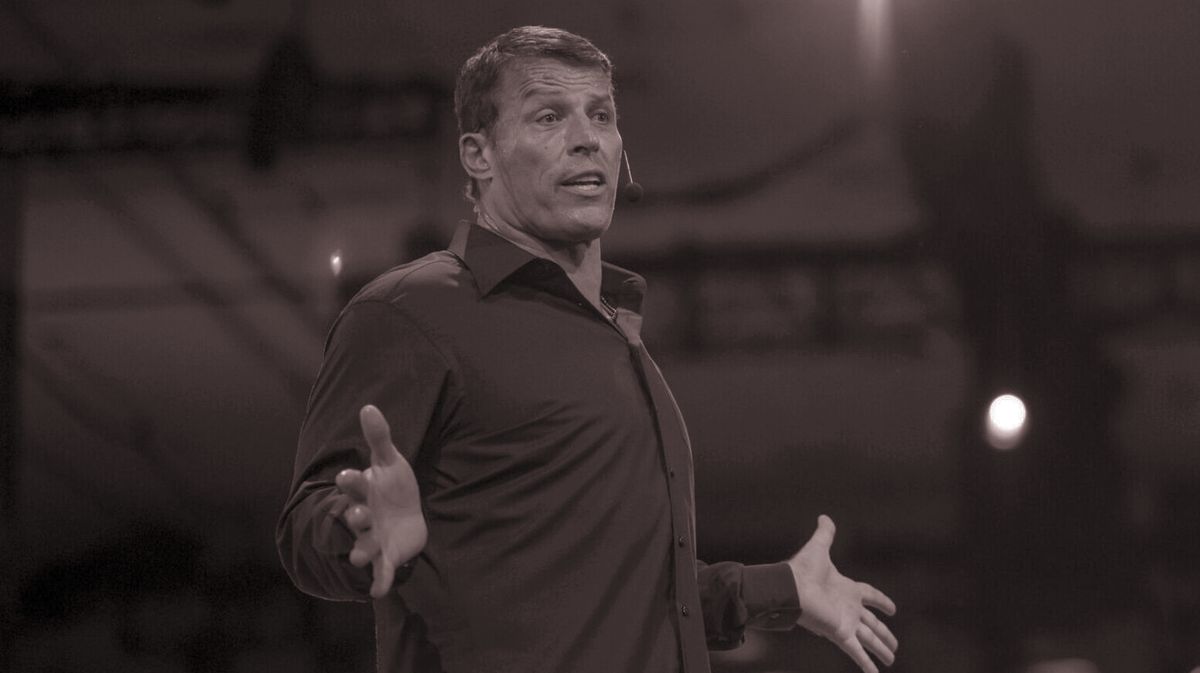
in a court of law. But who would have guessed that one of the first test cases would involve Tony Robbins, the centimillionaire motivational guru and peddler of self-help tomes based around power centers? Well, apparently Robbins is miffed about an A.I. chatbot that he claims offers a “studied impersonation” of him. Robbins, you see, already has his own “Tony Robbins AI,” and he’s none too pleased about a digital doppelgänger muscling in on his
brand.
Two weeks ago, Robbins quietly filed a lawsuit against InnoLeap and Mira Muse, the companies behind YesChat.AI, which offers subscribers access to “Tony Robbins GPT,” one among a roster of 200,000 interactive chatbots “trained to simulate the language, style, and knowledge of particular personalities.” But the thing is, almost no one has actually tested in court what happens when A.I. ingests a public
figure’s voice, image, and personality—and spits out a commercial imitation. Not surprisingly, the outcome of Robbins’s suit may have ripple effects across the entertainment industry. Robbins is asking for more than $12 million in damages, claiming violations of his right of publicity, trademark infringement, and unfair competition. (Here’s the complaint.)
As we know,
Hollywood studios and movie stars alike have been lobbying state legislatures to modernize likeness laws, while federal lawmakers dither over whether to intervene. More than 40 cases are pending over A.I.’s use of copyrighted books, films, and news articles. But as far as I can tell, no one has dared test Tennessee’s stringent ELVIS (Ensuring Likeness, Voice, and Image Security) Act in court. Signed last year by Governor Bill Lee, you may remember, it’s the first state law
that specifically tackles A.I.’s use of an actor or musician’s voice or image without consent, tipping the balance in favor of the creatives over the tech companies.
The ELVIS Act essentially draws a legal line between creative freedom and personal rights. Consider Tom Cruise. The Mission: Impossible star, as Brad Pitt recently reminded the world, delights in hopping around on the outside of airplanes. Suppose some ambitious auteur fed Cruise’s
entire oeuvre into an A.I. model and generated a dazzling stunt sequence. Would that be legal? Don’t answer too quickly. Because there are undoubtedly circumstances in which it might be perfectly lawful, and others where it decidedly wouldn’t. If Tony Robbins presses forward, his lawsuit might force courts to begin to provide clarity. And, frankly, the laws regarding this topic are in dire need of a reboot.
|
The only time the high court has
directly addressed the interplay between the First Amendment and state laws protecting a person’s name, image, and likeness was in 1977. Back then, Hugo Zacchini, the so-called “human cannonball,” persuaded the Supreme Court that a local Ohio TV station had effectively stolen his livelihood by broadcasting his entire act without permission.
Since then,
courts have recognized the right of publicity, but steadily narrowed its reach, often siding with content creators and broadcasters (though not always with video game publishers) when celebrities complain that their identities have been hijacked. Along the way, judges have borrowed tests from the copyright and trademark realms, weighing factors like whether a use is “transformative,” or considering whether it explicitly misleads consumers when there’s some artistic relevance to the use of a
celebrity’s name.
But recent Supreme Court decisions involving Andy Warhol’s art and a dog toy shaped like a Jack Daniel’s bottle have shifted the ground. The Court has placed greater emphasis on commercial purpose and shown less
deference to artistic intentions, potentially undermining decades of case law. Suddenly, the thread of jurisprudence that protects everything from lithographers silk-screening t-shirts of the Three Stooges to Ryan Murphy’s 2017 FX series Feud—which portrayed Olivia de Havilland against the then-100-year-old Oscar-winning
actress’s wishes—looks far less secure.
Perhaps it no longer matters so much whether artists are “adding significant expression” to the raw materials of a celebrity’s likeness. And perhaps, if a famous person’s name or face is being used to sell entertainment, creative license alone won’t be enough to fend off a lawsuit. Given
the current trend in rulings, studio lawyers are nervously eyeing the Ninth Circuit’s upcoming decision in a lawsuit brought by drag queen Vicky Vox, who alleges that Netflix misappropriated her cartoonized likeness in the LGBTQ superspy series Queer Force. There’s real anxiety that the court might make
it easier for plaintiffs to prevail in these sorts of cases.
Now, Tony Robbins may be the face of a new legal frontier. Of course, his case won’t be the only one shaping this terrain. Policy battles continue, like the California Senate’s unanimous vote last month to amend its likeness law to explicitly permit injunctions to block misappropriations of someone’s likeness, despite the Motion Picture Association’s warning it would chill free expression. And looming next year is the
expiration of the collective bargaining agreement between Hollywood producers and SAG-AFTRA, perhaps setting the stage for another bitter standoff over the protocols for incorporating A.I. into the industry’s daily business. (Yes, it’s that time again.)
Because yes, in the very near future, it’s entirely conceivable that the battleground will include a Tom Cruise GPT performing death-defying stunts on command. And the question will be: Who gets a piece of that?
|
Thanks, Eriq. I’ll see everyone on Thursday night.
Matt
|
|
|
The industry's go-to source for unflinching reporting on the trillion-dollar business of artificial intelligence -
perhaps the single most important technology of our time. Ian Krietzberg, the powerhouse journalist behind The Deep View, delivers twice-weekly insights into the latest dealmaking and breakthroughs in A.I., and how the intersecting worlds of finance, entertainment, media, and politics are being transformed in its wake.
|
|
|
Puck founding partner Matt Belloni takes you inside the business of Hollywood, using exclusive reporting and insight
to explain the backstories on everything from Marvel movies to the streaming wars.
|
|
|
Need help? Review our FAQ page or contact us for assistance. For brand partnerships, email ads@puck.news.
You received this email because you signed up to receive emails from Puck, or as part of your Puck account associated with . To stop receiving this newsletter and/or manage all your email preferences, click here.
|
Puck is published by Heat Media LLC. 107 Greenwich St, New York, NY 10006
|
|
|
|