Hello and welcome back to What I’m Hearing+, the Severance of the WIH Emmys. Congrats to
all of today’s nominees, especially those who chose not to give self-congratulatory media interviews about where they were when they heard the news.
Tonight, Eriq Gardner is back with fascinating (and separate) legal updates involving two longtime enemies, CAA’s Bryan Lourd and Ari Emanuel, formerly of Endeavor. One features the private equity powerhouse Silver Lake and a potential payout of more than half a billion dollars. All
yours, Eriq…
|
|
|
A MESSAGE FROM OUR SPONSOR
|
STAR POWER
High achievement. Higher adrenaline. With a twin-turbocharged V8, the Range Rover Sport delivers
heart-pounding intensity on every drive.
EXPLORE
|
|
|

|
Eriq Gardner
|
|
- Ormond v. CAA drags in Gwyneth
and Brad: There’s an update in actress Julia Ormond’s lawsuit against CAA, arguing that her former agency had a duty to warn her before sending her to a meeting with Harvey Weinstein in 1995. I was particularly taken by C.E.O. Bryan Lourd’s comments in a sworn deposition given two months ago, excerpts of which were unsealed last week. Lourd made sweeping statements about having no knowledge whatsoever of Weinstein’s sexual harassment issues
until the bombshell news reports broke in 2017. He also insisted that zero clients came to him with allegations of harassment by Weinstein—or anyone else. That flies in the face of Ormond’s own claim that she reported Weinstein’s misconduct to Lourd, only to have been dissuaded by CAA from reporting it to law enforcement.
The case has reached an unusual point: Ormond recently settled with Disney and Miramax over similar claims of enabling abuse, and CAA is now pushing back against those
companies for exiting the case without fully disclosing what they knew about Weinstein’s behavior at the time. In the meantime, CAA has seized the opportunity to spotlight the fruits of discovery so far, particularly a draft of Ormond’s unpublished memoir proposal, which recounts a troubling encounter with Weinstein that allegedly occurred before she signed with CAA.
I was also drawn to Weinstein’s own deposition in the case, such as when he admitted that he once made a pass at
Gwyneth Paltrow and later apologized to both her and then-boyfriend Brad Pitt. Paltrow, notably a CAA client, previously told The New York Times that she was 22 when Weinstein tried to massage her in a hotel room, and that she hadn’t suspected
anything improper would happen at the meeting because, as she described the scheduling notice, “It’s on the fax, it’s from CAA.” At the deposition, Lourd addressed the Paltrow episode, but for now, that portion of the transcript remains under wraps. CAA declined to comment, and for whatever it’s worth, Weinstein stuck up for the agency at his depo, declaring, “CAA is totally innocent in this situation.”
- A Michael Jackson shakedown in swimwear?: Next
time you spot a couple of well-dressed folks stripping down and diving into a Los Angeles hotel pool, think: This might just be a Hollywood negotiation where everyone wants to be sure that no one else is wearing a wire. Consider an arbitration petition recently filed by Michael Jackson’s estate against Frank Cascio, a former personal assistant to the King of Pop who’s now accused of orchestrating a $213 million shakedown.
According to the estate, the
drama began in 2019, right after Leaving Neverland unleashed a wave of negative publicity over allegations of child sexual abuse. Cascio allegedly tried to capitalize on the scandal, with his reps demanding a private poolside meeting at the Sunset Marquis—in bathing suits only. The estate, represented by Marty Singer, characterized the request as “bizarre,” adding, “Only someone engaging in extortion or other unlawful conduct would be worried about their conversation
being recorded.” Shortly afterward, Jackson’s heirs inked a lucrative consulting agreement with Cascio that included strict confidentiality clauses. But those hush payments haven’t kept Cascio quiet. The estate claims he’s now demanding even more money and threatening litigation.
The estate is hoping to shove the entire dispute into arbitration and bury whatever Cascio might reveal. But that process is unlikely to be simple. Cascio, represented by Mark Geragos, is
expected to file his response any day now—and odds are his side of the story will look very different.
- More Bravo drunk Housewives drama…: When last I checked in on the dramedy that is Leah McSweeney’s lawsuit against Bravo, a judge had significantly pared down her claims. The former Real Housewives of New York star was left
trying to strengthen what remained of her case before it entered discovery. She’s still pressing allegations that, as a struggling alcoholic, she endured a hostile work environment during her time on the show, and she’s also trying to bolster her claim of retaliation after accusing Andy Cohen of using cocaine behind the scenes.
(Cohen has strenuously denied the allegations.)
But the case could now take an unexpected detour. McSweeney’s original complaint included a claim for sexual harassment—which triggered the federal Ending Forced Arbitration of Sexual Assault and Sexual Harassment Act. But after Judge Lewis Liman dismissed that claim in March,
NBCUniversal saw an opening to steer this high-profile dispute out of court and into arbitration. This has set the stage for resolving a potentially significant legal issue. In the past few years, plaintiffs have increasingly tried to wedge sexual misconduct allegations into their complaints to invoke the EFAA shield. But what happens when those claims get tossed, and yet other parts of the lawsuit survive? We’re about to find out.
McSweeney is arguing that it’s too late to force
arbitration now—and she’s also pointing to Bravo’s prior public promises not to enforce confidentiality clauses against reality stars when abuse is alleged.
- No privileges for publicist emails: Lately it’s been the law firms, not the clients, that are hiring crisis management P.R. firms. One key reason is the hope of cloaking publicist communications under attorney-client and work product privileges. That tactic has recently sparked a legal
debate—including in the Blake Lively–Justin Baldoni saga—over whether there’s some sort of “P.R. privilege” that shields publicist emails and texts from civil subpoenas.
Yesterday, a judge weighed in, ruling that a P.R. firm’s materials couldn’t be withheld. The decision (read it here) came out of Black Diamond Capital
C.E.O. Robert Rothman’s lawsuit against Bank of America. Rothman has alleged that the bank conspired with the NFL to cut him out of a minority stake in the Washington Commanders. According to Rothman, bankers told him the franchise was worth no more than $3 billion and that Dan Snyder would never sell—only for the team to go to Josh Harris in 2023 for roughly twice that price. Behind all the maneuvering was an orchestrated P.R. campaign, the
details of which may now see the light of day thanks to rulings like this.
|
|
|
Nothing obscene about this week’s main story, unless you count the ways that lawyers try to entice
investors to sue Ari Emanuel. Or the amount of money at stake…
|
|
|
Today a court in Delaware began considering who would steer the
appraisal challenge over the price that the private equity firm paid to take Ari Emanuel’s media and representation business private. It’s as messy—and as lucrative—as it sounds, and has two prominent law firms vying for fees as high as half a billion dollars.
|
|
|
When Endeavor executives Ari Emanuel, Patrick Whitesell, and Mark
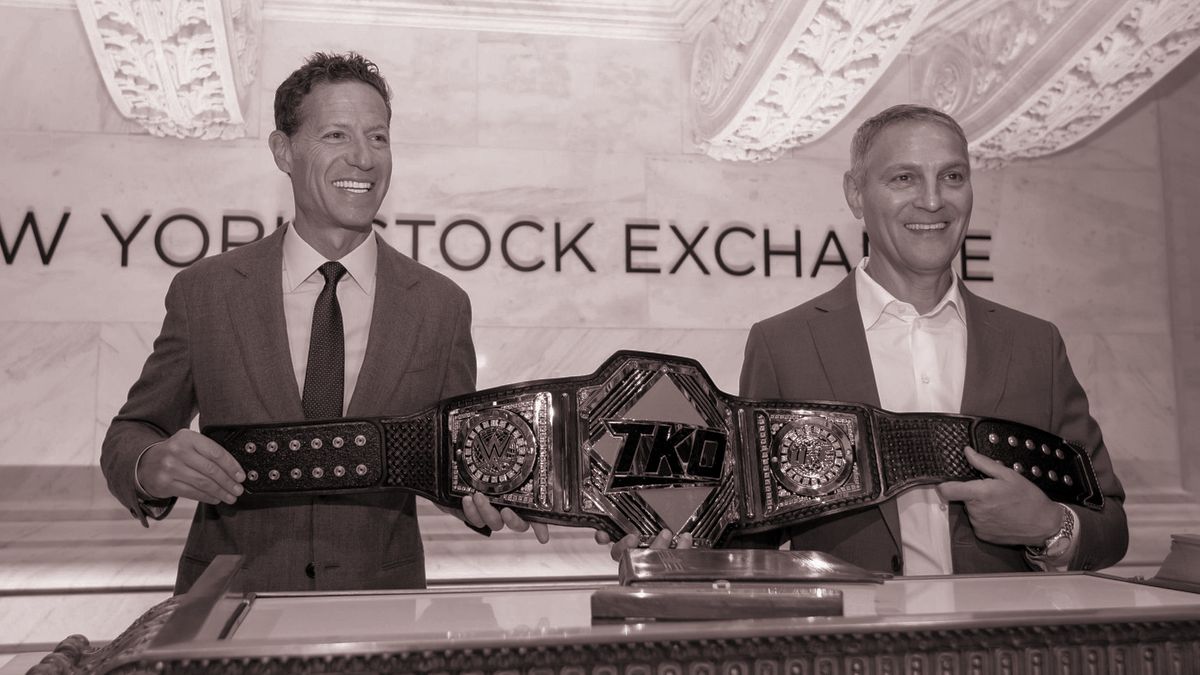
Shapiro gathered the troops for a town hall back in April 2024 to unveil their grand plan to take the company private—yet again—no one in the room could have foreseen the financial pyrotechnics and legal bar brawl that would follow. The original plan, after all, seemed straightforward enough. Private equity giant Silver Lake agreed to buy out Endeavor’s public shareholders at $27.50 a share, valuing the whole enterprise—the WME talent agency, a 51 percent stake in TKO (parent of WWE and
UFC), plus a curious assortment of tennis tournaments, New York Fashion Week, and even a bull-riding league—at around $25 billion.
It didn’t seem crazy; Endeavor had I.P.O.’d three years earlier at $24 a share, and the stock had basically flatlined since then. If anything sparked gossip, it was the idea that Emanuel would be rolling over his shares while Whitesell might walk off into the sunset with a $60 million payday. (Disclosure: WME represents Puck.)
But a funny thing happened
on the way to the octagon. Between the privatization announcement and the actual squeeze-out this past April, the share price of TKO nearly doubled, sending Endeavor’s stake soaring in value. Suddenly, that $27.50 offer looked downright miserly. Investors began piling in, betting that the Delaware Court of Chancery would side with them.
|
|
|
A MESSAGE FROM OUR SPONSOR
|
STAR POWER
High achievement. Higher adrenaline. With a twin-turbocharged V8, the Range Rover Sport delivers
heart-pounding intensity on every drive.
EXPLORE
|
|
|
But the lawsuits didn’t just come courtesy of the usual suspects—savvy operators hoping to squeeze out a few
extra nickels, like George Soros, Carl Icahn, Israel Englander, and Matt Halbower. Some of the sharpest legal minds in the Delaware bar, attracted by the scent of a potentially gargantuan payday in legal fees, also stepped in. Indeed, the case has now ballooned into the largest appraisal action in Delaware history, with lawyers jockeying for a fee package that could stretch into the nine figures or more.
This
morning, the saga crescendoed in a fairly heated, high-stakes Zoom hearing before Delaware Vice Chancellor Lori Will—a proceeding I was fortunate enough to dial into, coffee in hand, as billion-dollar stakes and bruised egos collided in real time. Cue the mudslinging, allegations of shady client recruitment, and enough open conflict to make a WWE cage match look civil.
|
On its face, Vice Chancellor Will’s task seemed simple: decide which group of attorneys would steer the
consolidated legal challenge over the price that Silver Lake paid to take Endeavor private. Only two were truly in contention, their primary differences being how they structured their fees and how many aggrieved Endeavor investors they’d managed to sign up.
But never underestimate the devil in those details. Consider compensation. The so-called “A&B Group,” led by Abrams & Bayliss, negotiated an hourly rate for handling the case, which is estimated to total around $50 million in fees.
This, one imagines, makes perfect sense if the litigation turns out to be merely an exercise in recalculating Endeavor’s value after TKO’s stock surge. In that scenario, everyone goes home richer, and no one misses a tee time.
At the hearing, Tom Bayliss projected confidence that there would be substantial winnings in this case. He nodded to the “truncated” special committee process that had engineered Endeavor’s privatization. And he showed a graph illustrating that, if
TKO’s increased value is the only thing considered, the price paid per Endeavor share should be $39 rather than $27.50. “Now, we think that is too low,” he quickly added, “and why this appraisal case is different from most other appraisal cases—the biggest in the history of Delaware courts. There are a lot of circumstances when a contingency arrangement makes sense because you need the law firm to take on risk, because you don’t have the scale you have here. This is not one of those
cases.”
But suppose the case fails to resolve itself neatly and instead drags on for years, as these things so often do. In that event, Vice Chancellor Will might find herself persuaded by the approach of the rival “RKS Group,” led by Rolnick Kramer Sadighi. In their proposed fee arrangement, the lawyers would collect 20-25 percent of any increase in the deal price—a potentially staggering sum. Court papers outline one scenario in which investors would stand to gain $2.35 billion,
translating to $587 million in legal fees (plus interest accruing at an estimated $1 million per day). Yet despite the eye-popping numbers, the RKS argument is that a straight percentage split of the winnings would align the interests of lawyers and clients, sparing investors the agony of watching billable hours pile up for the next decade while their money disappears into a legal black hole.
Could the Endeavor saga devolve into exactly that sort of interminable trench warfare
where an eventual jackpot isn’t really secure? Absolutely. The plaintiffs could lose, of course. Latham & Watkins—counsel for Silver Lake—isn’t the sort to roll over easily. And as the RKS team pointed out, most appraisal actions in recent Delaware history have ended in heartbreak for those hoping to prove corporate buyouts were cheapjack affairs. It all traces back to a 2017 Delaware Supreme Court ruling that reversed a trial judge’s conclusion that Dell Inc. had been undervalued by $7 billion
in its own management-led buyout. “Despite my bullishness for the case, all appraisal cases carry risks,” said RKS partner Larry Rolnick. “And nothing demonstrates my belief in the case more than my willingness to litigate the case at risk to myself such that if we don’t recover, we don’t earn a penny. And our clients prefer that, prefer to have a firm with skin in the game.”
The RKS lawyers even sketched out the “not hypothetical” hypothetical that this entire adventure
ends with Endeavor itself tipping into insolvency, leaving everyone fighting for scraps. They noted that Silver Lake’s acquisition was heavily leveraged, and that parts of Endeavor—the bull-riding league among them—have already been spun off to TKO. Adding fuel to the fire, Silver Lake has announced it has no
intention of prepaying dissenting shareholders—which, under Delaware law, would mean that they’d escape any interest payments should a court later rule against them. To hear Rolnick tell it, that announcement was a naked ploy to sow fear. “In my opinion,” Rolnick declared, “this statement was designed to discourage shareholders from electing to pursue their appraisal rights by threatening them with the possibility that the merger consideration might be at risk.”
|
Then there’s the explosive and fast-evolving question of investor alignment in what currently stands as the
largest public-to-private deal in the history of the media and entertainment sector. Stockholders have demanded an appraisal of roughly 150 million Endeavor Class A shares. Until just days ago, investment funds controlling about 60 percent of that total sided with the RKS Group, and the remainder aligned with the A&B Group.
But on the eve of today’s hearing, the balance shifted dramatically. A pair of major investment funds—including Pentwater Capital (which a few years ago successfully
bet on a Delaware court forcing Elon Musk to complete his Twitter purchase)—defected to A&B, leaving that side representing about 75 percent of the shares.
Despite its newfound strength, A&B remains on the offensive. It alleges that its rival employed dubious tactics to build its client roster—namely, by cutting sweetheart deals with favored investors. Court filings have revealed that RKS dangled an “early mover discount,” charging a 20 percent contingency fee to
investors who signed on quickly, compared to 25 percent for those who hesitated, with even steeper discounts for holders of more than 10 million shares. Those who declined were allegedly warned that they’d be “sidelined” from any meaningful role in the case.
A&B argues these tactics were “coercive,” characterizing the tiered discounts as a form of “kickback” worth tens of millions of dollars to large investors. A&B has even invoked the name of Bill Lerach, the
once-dominant securities class-action lawyer who was imprisoned in 2008 for orchestrating a kickback scheme and eventually disbarred. At the hearing, Vice Chancellor Will recoiled at the comparison. “This is sad food fighting,” she remarked.
For its part, RKS defended its client procurement methods, dismissing allegations of unethical kickbacks as baseless. “How ironic,” said Steve Hecht, a partner at RKS. “Here I am in court justifying why we, the lawyers, discounted our
fee. … Volume discounts are a universally recognized principle. A&B is trying to turn this very routine practice into something nefarious, like we’re the criminals.”
Hecht even told the chancellor that he considered some of the accusations to be defamatory. But A&B didn’t let up. “The reason that we are here is because my clients are angry,” said Bayliss. “They felt coerced, and they felt they were lied to. … The problem is not the discounts. The problem is some got discounts which others
didn’t know about.”
As for how the tables had turned, with A&B now representing a clear majority of investors, RKS signaled it would accept a co-counsel arrangement—despite previously cautioning that such an approach would create “governance nightmares.” The judge noted the irony, while Bayliss added, “When they were larger than we were, they acted like bullies.” Vice Chancellor Will promised a decision within a week.
|
Thanks, Eriq. See you all back here on Thursday.
Matt
|
|
|
Puck founding partner Matt Belloni takes you inside the business of Hollywood, using exclusive reporting and insight to explain
the backstories on everything from Marvel movies to the streaming wars.
|
|
|
The industry's go-to source for unflinching reporting on the trillion-dollar business of artificial intelligence - perhaps the
single most important technology of our time. Ian Krietzberg, the powerhouse journalist behind The Deep View, delivers twice-weekly insights into the latest dealmaking and breakthroughs in A.I., and how the intersecting worlds of finance, entertainment, media, and politics are being transformed in its wake.
|
|
|
Need help? Review our FAQ page or contact us for assistance. For brand partnerships, email ads@puck.news.
You received this email because you signed up to receive emails from Puck, or as part of your Puck account associated with . To stop receiving this newsletter and/or manage all your email preferences, click here.
|
Puck is published by Heat Media LLC. 107 Greenwich St, New York, NY 10006
|
|
|
|