Hello, and welcome back to The Best & The Brightest. I’m Peter Hamby in Southern
California, where it never rains, except when it does.
Tonight, my report on how Democrats seem to finally be finding their voice after a year of anguish. From coast to coast, Democratic candidates this midterm year are embracing a message of fighting—yes, fighting Trump, but also fighting billionaires and fighting for the working and middle class. The populist rhetoric is catching on, uniting the party’s warring factions and giving Dems a way to pivot away from
unpopular cultural issues they’d rather avoid. Can they fight all the way to November?
Also mentioned in this issue: Jesse Jackson, Robin Kelly, Elon Musk, Ro Khanna, Jon Ossoff, George Soros, Mary Peltola, Graham Platner, Zohran Mamdani, Mikie Sherrill, Gavin Newsom, Beto
O’Rourke, Chris DeLuzio, Alyssa Cass, Ruben Gallego, Alexandria Ocasio-Cortez, Evan Roth Smith, Bernie Sanders, Hillary Clinton, Zach Wahls, John Edwards, and more…
|
|
|
Instagram Teen Accounts default teens into automatic protections for who can contact teens and the content they can
see.
Now, content settings are inspired by 13+ movie ratings, with a new stricter setting for parents who prefer extra controls.
Explore our ongoing work to keep teens safe online.
|
|
|

|
Abby Livingston
|
|
- Remembering Jesse Jackson:
Civil rights icon Jesse Jackson died today at the age of 84, drawing a flood of remembrances from Democratic luminaries including the Clintons, Barack Obama, Joe Biden, and Kamala Harris. Even Donald Trump had something nice to say on social media about the former Democratic presidential candidate, whom he called a “good man, with lots of personality, grit, and ‘street smarts.’” (Trump also
took the opportunity to swipe at various critics, including “Barack Hussein Obama, a man who Jesse could not stand,” as well as the “Radical Left.”)
In addition to his national stature, Jackson also built a political dynasty in his home state of Illinois, where two of his three sons have served in Congress. One of them, Jonathan Jackson, currently reps parts of Chicago after being elected in Illinois’s 1st District in 2023. Jackson’s better-known eldest son, Jesse
Jackson Jr., served in Congress from 1995 to 2012, went to prison in 2013 for spending $750,000 in campaign money on personal items, and is currently attempting a political comeback—he’s running in IL-02’s Democratic primary to replace Rep. Robin Kelly, who’s running for Senate.
The election takes place a month from today, and Junior likely has incredible name recognition but has struggled to raise serious cash. In fact, he’s third in total money raised among
Democratic contenders, with only about $90,000 in cash on hand as of the end of December.
|
|
|
Democrats still can’t do much of anything until they reclaim at least one chamber of
Congress, but they’re finally figuring out how to speak about Trump without losing the plot. Fresh polling from Blueprint Research measures which messaging is actually landing with voters.
|
|
|
One year ago, right around this time, Democrats were hollering into the void. Donald Trump
had begun his campaign to destroy decades of liberal governance, letting Elon Musk bull-DOGE the federal bureaucracy, unleashing platoons of masked federal agents into public spaces, appointing a Fox News host to run the world’s most fearsome military, and on and on. Terrified liberals demanded their Democratic leaders in Congress, shunted to the impotent minority, find some way to fight back. A common refrain—“Do something!”—rang out from countless
demonstrations, social media posts, and real-world protests alike. Things were looking pretty bleak.
In early 2025, I remember watching anguished Democrats in Riverside, California, line up to throw verbal haymakers at Democratic Rep. Ro Khanna, who was visiting as part of a masochistic Trump 2.0 listening tour. “The Democratic Party just
can’t get its shit together!” Vickie Dunlap, a retired Army command sergeant major, yelled at him. Riyadh Cooper, a 45-year-old combat veteran in a Dodgers hat, scolded the congressman further. “I want to know why in the world the Democratic Party hasn’t fought yet,” he demanded of Khanna, who calmly played therapist and told the crowd to just keep showing up and organizing.
A year on, Democrats still can’t do
much of anything until they reclaim at least one chamber of Congress this November. But they are figuring out how to talk—or at least, how to not sound like total weenies. Democrats around the country, now in an election year, are learning how to speak about Trump with righteous anger, but without losing the plot. A prime example: a speech given two weeks ago by Georgia Sen. Jon Ossoff, running for reelection in purple Georgia, that went mega-viral. By
my tally, clips from the speech have been viewed over 11 million times on his campaign accounts, with many millions more views via other liberal accounts.
Speaking to a crowd in Atlanta, Ossoff hit all the outraged notes that many news-reading, educated Democrats in the audience probably wanted to hear. He mentioned corruption, democracy, that racist clip Trump posted about the Obamas, and even Jeffrey Epstein. But crucially, Ossoff
didn’t make everything about Trump alarmism. He brought distant concerns home by tying Trump’s behavior to real-life worries that matter to voters in his battleground state—healthcare, the cost of living, the growing gap between rich and poor, anxieties about new and powerful technologies. “Prices are up, jobs are going away, Medicaid and school lunches are slashed, nursing homes are getting defunded,” Ossoff said as he whipped up the crowd. “Trump was supposed to fight for the working class.
Instead, he is literally closing rural clinics and hospitals to cut taxes for George Soros and Elon Musk.”
Bundled together, the message was clear: Trump and his billionaire cronies are looking out for themselves. They forgot about working people. But Democrats are fighting for you. Ossoff isn’t the only one taking this populist angle. It’s showing up with striking consistency in Democratic races nationwide, where candidates for House, Senate, and governor are
positioning themselves as “fighters” against rich and powerful interests in Washington. In Iowa, wheelchair-basketball Paralympian Josh Turek told voters that “Iowans deserve to have someone fighting for people, fighting for social and economic justice, fighting for the most vulnerable.” In Alaska, Senate hopeful Mary Peltola said she is running against “a rigged system” in Washington and promised “systemic change” to bring down
grocery costs. In Maine, Graham Platner launched his campaign promising to “fight for the things you love.” (Dem communications directors, please don’t come for my inbox. I know your candidate is doing it, too, I promise!)
|
|
|
Instagram Teen Accounts default teens into automatic protections for who can contact teens and the content they can see
– now with content settings inspired by 13+ movie ratings.
Nearly 95% of parents say Teen Accounts help them safeguard their teens online. And we’ll continue adding new protections.
Explore our ongoing work to keep teens safe online.
|
|
|
Some Democrats, like Platner, have been talking this way since last year. Others are just starting to weave
it into their stump speeches. Meanwhile, just look at the Democrats who won elections last November: Zohran Mamdani, who pledged to confront systemic economic unfairness in New York City; Navy pilot Mikie Sherrill, who promised to fight to lower costs in New Jersey; and then there’s Gavin Newsom, with this Prop 50 campaign and fire-breathing anti-Trump rhetoric, which has put him on top of 2028 presidential
polls. Democrats aren’t interested in breaking bread with Republicans. Fighting is catching on—and voters are responding.
|
“Voters Do
Not Like Backward Looking”
|
Researchers at the Democratic polling firm Blueprint Research noticed this trend too—and decided to measure
how it was landing with voters. In December, they put together a large-scale online survey testing modified statements from 10 prominent Democratic leaders, each offering slightly different visions for the party’s future. The breakout winners, Blueprint found, were messages that included some kind of “fight” or “fighting” language.
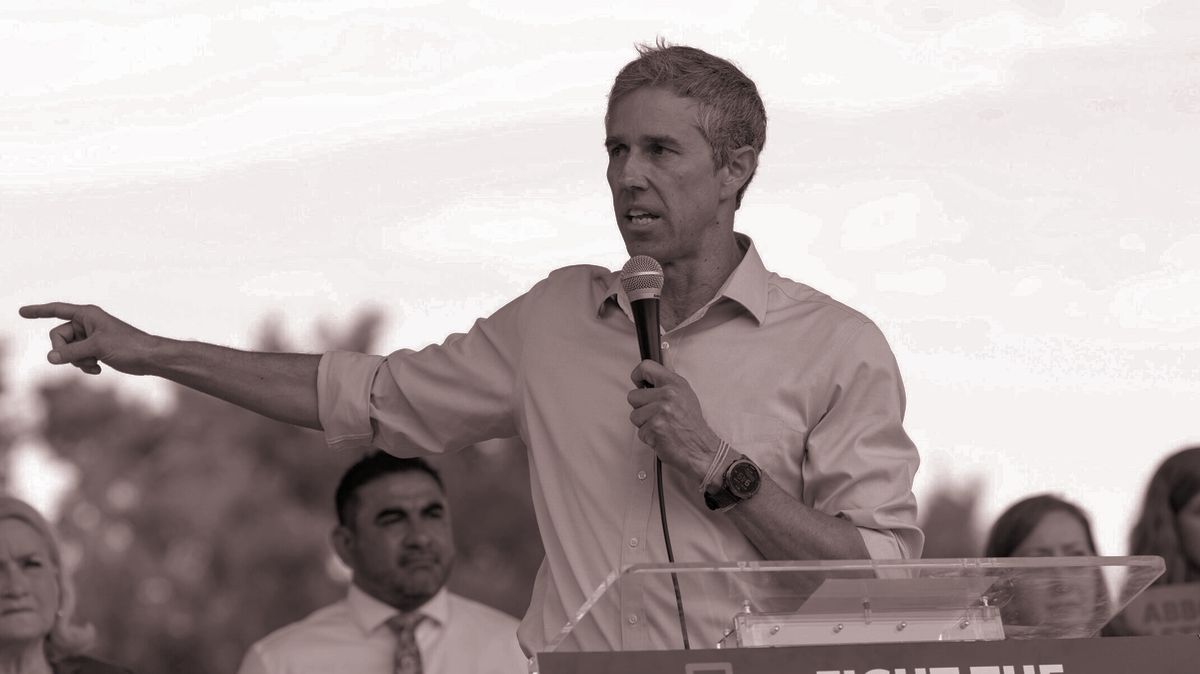
The best-received message came from the F-bomb-loving Texan Beto O’Rourke, with a call to arms that was both pugilistic and patriotic:
“Imagine a Democratic Party that fights—really fights—for all of us. No rolling over, no bending over, no big money and corporate politics. A message defined by people in every state, not consultants and pollsters, no matter who you are, we’re here to listen, learn, and work with you.” That line had a +14 preference effect compared to other messages that Blueprint tested—both with Democrats and independents. Another message, from Pennsylvania Rep. Chris DeLuzio,
about “fighting to restore the American dream,” also received high marks among both Democrats and independents, followed by a call from Mamdani to take on big challenges to help working people get ahead.
Other Democratic messages measured by Blueprint missed the mark. A Pete Buttigieg line about “building” and protecting old institutions played well with independents but sank with Democrats. A Ruben Gallego riff about
“freedom” also left Democrats wanting. Alexandria Ocasio-Cortez urging Democrats to “start calling out oligarchy as the problem” predictably scored points with Democrats but underperformed badly with independents.
I asked Blueprint why the fight mantra is catching on. “First, it’s forward-looking,” said Blueprint chief strategist Alyssa Cass. “After a year of Trump being president, the country just feels worse off and on a bad trajectory.
In that atmosphere, we want fighters, not people engaged in inside-baseball online debates or consultant-speak.” Voters everywhere harbor deep concerns about their economic future, Cass told me. Candidates who speak authentically to those fears—as Ossoff did in Atlanta—come off as more relatable than candidates relying on a traditional, paint-by-numbers playbook.
Cass said that running as populist fighters against Trump allows Democrats to keep the focus on kitchen-table issues—energy
costs, healthcare access, housing, etcetera—and not get distracted by cultural warfare or debates over democracy and fascism. After all, neither feels very relevant when the debt collectors keep calling. She pointed to Blueprint research showing that Democratic messages attacking wokeness and terms like “BIPOC” and “Latinx”—a course correction after Joe Biden and Kamala Harris were tarred in 2024 as out-of-touch urban libs—whiffed not just with Democrats, but
with independents too. “It’s not December of 2024 anymore,” she said. “Voters do not like backward-looking. Woke-punching is just not a way to rehabilitate the Democratic brand or engage voters. You’re telling on yourself that you have no real ideas when you go there.”
Evan Roth Smith, the lead pollster for Blueprint, said that bringing up unpopular culture war topics or woke language—even when condemning them—just gives Republicans an
opportunity to change the subject from Trump’s unpopular brand and rising concerns about the economy that are top of mind in the midterms. “The message for Democrats is crystal clear,” Smith told me. “Focus on concentrated money and power as the chief villain standing in the way of gains for the working and middle class. Reiterate that the Democratic Party always stands on the side of the little guy against the powers that be. Keep policy simple, direct, and within that framework. And don’t
talk about anything else that Republicans want to move the conversation to.”
|
All this talk of fighting—fighting for the working class, fighting the billionaires, fighting a corrupt
system—might seem like the party establishment stealing a page (a whole book?) from Bernie Sanders–style class politics. But it’s also just the Democratic Party returning to its middle-class roots, before the party became distracted by identity politics, the demands of activist groups, and social media trends that appealed to an increasingly affluent and educated voter base.
|
|
|
Obama won twice by running against powerful corporate interests, prioritizing affordable healthcare, fighting
to keep people in their homes during the mortgage crisis, and siding with organized labor to rescue the auto industry. Obama’s execution wasn’t perfect (Occupy Wall Street, we see you!), but populist economics remained his North Star during both terms. Those efforts managed to hold at bay any significant political revolt on the left until his final years in office, when Sanders emerged to challenge Hillary Clinton for the 2016 Democratic nomination.
On
Tuesday, I talked to Turek, the Iowa Senate candidate, who is locked in a primary contest with fellow Democrat Zach Wahls. Turek said that campaigning as an economic fighter is just common sense that Democrats somehow lost sight of in the Trump era. “John Edwards said it back in 2008,” he told me. “We are living in two Americas. We were always the party of the working and middle class, but I don’t think that message has
resonated enough. We can’t talk over people’s heads. We have to be genuine.”
Turek said that when he’s asked about culture war topics, he changes the subject to more salient issues for Iowans—healthy drinking water, functioning schools, soaring energy bills. “We have to get back to being the party of the people,” Turek told me. “Iowans see a system that is unfair, only looking out for billionaires and donors and large corporations and a system that is bought and paid for. Working-class
people and middle-class people are being left behind.”
Obama won Iowa twice, but the state has become tough sledding for Democrats since: Turek rarely name-checks Trump in a state the president won by 13 points in 2024. Fittingly, Turek’s campaign leans heavily on underdog imagery. He grew up working class in Council Bluffs, and is wheelchair-bound thanks to childhood spina bifida, which forced him to have 21 surgeries before the age of 12. He went on to win two Paralympic gold medals in
wheelchair basketball, and, after that, a seat in the Iowa State House. He won in his red district, in part, by campaigning door-to-door in his wheelchair.
Turek’s campaign ads project grit: He’s seen hoisting himself up steep staircases with his arms, and dragging his wheelchair behind him, just to meet voters at their door. “I have had to fight for everything my whole life,” he told me. “I am the American dream, and I want to fight to make that dream accessible to the next generation.”
After our short conversation, I did a Ctrl-F search of my notes. Turek had used a variation of the word “fight” 13 different times in 10 minutes.
|
|
|
Join Puck’s chief political columnist, John Heilemann, as he roams the corridors of power and influence in America on this
twice-weekly interview show, taking you beyond the headlines with the people who shape our culture: icons and up-and-comers, incumbents and insurgents, moguls and machers in the overlapping worlds of politics, entertainment, tech, business, sports, media, and beyond. The conversations are rich and revealing, unrehearsed and unexpected… and reliably impolitic. A Puck-Audacy joint, new episodes drop every Wednesday and Friday.
|
|
|
Unique and privileged insight into the private conversations taking place inside boardrooms and corner offices up and down Wall
Street, relayed by best-selling author, journalist, and former M&A senior banker William D. Cohan.
|
|
|
Need help? Review our
FAQ page or contact us for assistance. For brand partnerships, email ads@puck.news.
You received this email because you signed up to receive emails from Puck, or as part of your Puck account associated with . To stop receiving this newsletter and/or manage all your email preferences, click here.
|
Puck is published by Heat Media LLC. 107 Greenwich St., New York, NY 10006
|
|
|
|



_01KGJP27KYQWBZQE1VZK0EYN88.jpg "Instagram")
_01KGJP24K5SK9GN77TC2TYTPN4.png "Instagram")
_01KGJP21X2KFNG9E5VTMRPTZZP.png "Instagram")