Welcome back to The Best & The Brightest. I’m Peter Hamby. Happy
TACO Tuesday.
Tonight, I have the exclusive on how the Democratic super PAC Priorities USA is trying to reimagine digital advertising for our scatterbrained attention economy—and how their operatives are trying to convince stubborn Democrats that YouTube now matters more to voters than linear TV. Up top, Abby Livingston previews Dems’
first-quarter fundraising numbers, and detects a donor thaw after the post-2024 deep freeze.
Mentioned in this issue: JoAnna Mendoza, Juan Ciscomani, Christina Bohannan, David Plouffe, Mariannette Miller-Meeks, Joe Rogan, Danielle Butterfield, Jon Husted, Sherrod Brown, and more…
|
|
|
|
Claude, the AI for problem solvers
AI helps most with the hardest work, not the simplest. Anthropic analyzed 2 million conversations and found Claude's biggest impact
is on complex, college-level tasks. The Economic Index tracks adoption across every state and occupation.
See how your state uses AI.
|
|
|
|

|
Abby Livingston
|
|
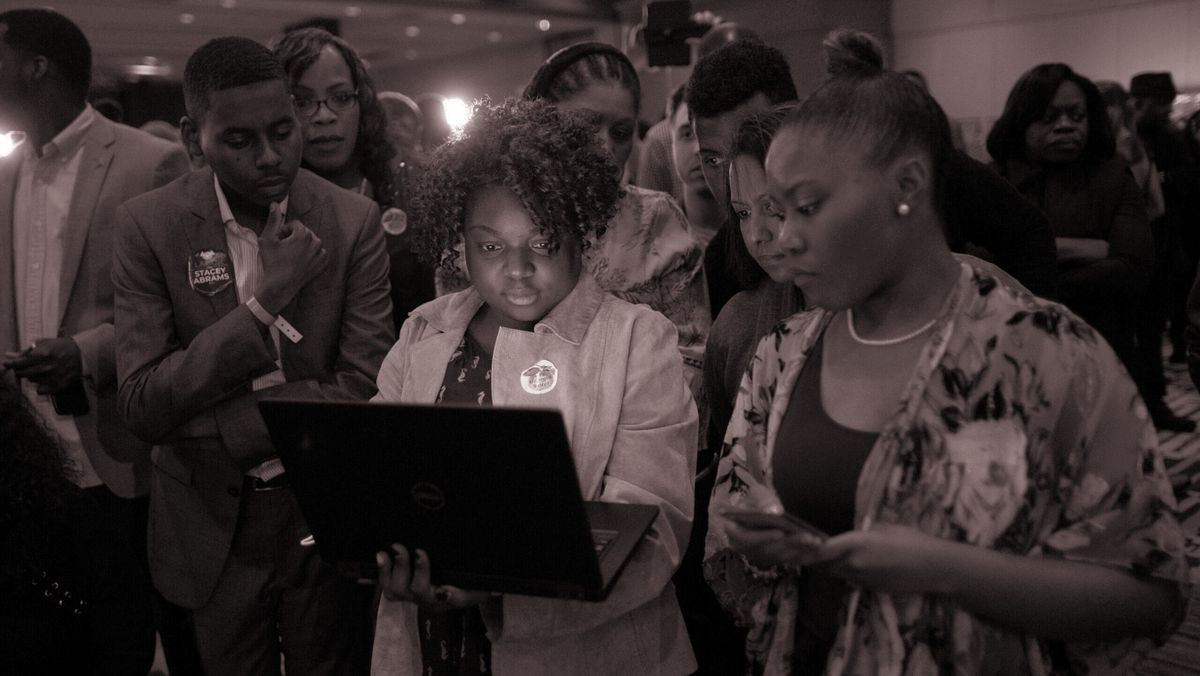
Democratic candidates have begun to flaunt first-quarter donation numbers, and early indications
point to a party starting to shake off its post-2024 fundraising stupor. I spoke to one Republican operative who was exceptionally worried that Democrats were kicking into high gear. JoAnna Mendoza, this person noted, raised $2.3 million in her race against Arizona Rep. Juan Ciscomani, while Christina Bohannan raised $2 million in her showdown with Iowa Republican Rep. Mariannette Miller-Meeks. (The incumbents haven’t
released their numbers yet.) “Dems have unleashed the beast,” the Republican told me. “Some Republicans have as well, but Dem donors are opening their wallets, and it shows across the board.”
This certainly feels like a departure from last year, when Democratic donors mostly blamed party leaders for the electoral shellacking they’d just experienced, and intimated
they’d be directing money to individual candidates rather than faceless campaign committees. The solid numbers coming out of certain campaigns may be the first sign of a thaw. Still, Republicans have so much money stashed away in various Congress- and Trump-controlled stockpiles that it will still be a long time before Democrats get anywhere close to cash-on-hand parity.
|
|
|
|
And now for the main event…
|
|
|
|
The Democratic outside group Priorities USA is hoping to “take back the internet” by meeting
young, politically checked-out swing voters where they are: guzzling sports clips on YouTube and commenting on video game streams. They’re starting with Ohio—and looking to ’28.
|
|
|
|
In the coming weeks, gamers in Ohio—mostly apolitical young men—will start to see a certain ad on YouTube
when they hop on the platform to watch video game content. It looks and sounds a lot like the short interstitial ads that social media–addled users have grown accustomed to: a random guy wearing headphones sitting next to a podcast mic and talking straight-to-camera; bold, rapid-fire text; quick-cut edits; and a loud, fast-talking voiceover. “If you play video games, you might’ve noticed your power bills are just a wee bit higher these days,” the narrator
explains. “Well, you can thank this guy, Ohio Senator Jon Husted.”
In a brisk 20 seconds, the spot outlines Husted’s connections to a bribery scandal involving FirstEnergy, one of Ohio’s largest energy utilities. What it doesn’t mention is that Husted, a Republican, is running for reelection in November against the state’s former Democratic senator
Sherrod Brown, who lost his seat in 2024. “[Husted] sides with the power companies while our bank accounts get cooked,” the ad says, before ending with, “Oh! I almost forgot about the Epstein stuff. But we’re out of time, so just Google it.” (Husted has denied wrongdoing and hasn’t been charged with a crime.)
|
|
|
|
Claude, the AI for problem solvers
AI helps most with the hardest work, not the simplest. Anthropic analyzed 2 million conversations and found Claude's biggest impact
is on complex, college-level tasks. The Economic Index tracks adoption across every state and occupation.
See how your state uses AI.
|
|
|
|
The spot is the handiwork of Priorities USA, the Democratic outside group that launched as a major-donor
super PAC in the Obama years but has since reorganized itself around digital advertising and training party staffers to reach fickle voters on the internet. Their mission is to convince Democratic decision-makers that the vibe and vocabulary of TV advertising just doesn’t work on the platforms where voters increasingly spend their time. They are also hoping to remind political insiders that the vast majority of Americans don’t engage with political or news content every day, and
many never do at all. “Forty-two percent of voters just don’t pay attention to the news and consider themselves apolitical,” Danielle Butterfield, the PAC’s president and executive director, told me. “We have to be able to infiltrate their feeds in nonpolitical spaces. Even with paid media, we have to be contextually and culturally relevant.”
That mandate requires innovating on stale formats, especially as Democrats grapple with the migration of voters of
all ages to streaming and digital—a behavioral shift that still seems lost on party leaders and media consultants who control campaign budgets. Priorities’ recently conducted landscape analysis of paid advertising during the 2024 election found that 70 percent of ads that ran on YouTube were originally television spots that had been cut down and uploaded to the platform. Of the top 10 presidential campaign ads with the most spending behind them on YouTube, nine were simply duplicates of
TV ads. “That stat is pretty alarming,” Butterfield told me. “It just illustrates that while we are moving a lot of money away from TV into digital, it’s really just a copy paste of television onto digital tactics.”
Meanwhile, Obama campaign guru David Plouffe—whether he’s late to the think-like-a-creator game or not—argued in The New York Times this week that Democrats need a whole new approach to how they run elections. “Candidates and
incumbents should center each day on content creation,” Plouffe wrote. “That does not mean uploading the same video to every platform. It means creating output tailored specifically for TikTok or Instagram or YouTube.”
For Priorities, all those platforms matter, but YouTube is the star player. In their research, Priorities found that YouTube alone has a wider reach than linear TV by 15 points: It reaches 80 percent of all voters (and 86 percent of coveted Latino voters) in a given week,
compared to 62 percent for cable or broadcast TV. Meanwhile, nearly 40 percent of adults trust independent creators as much as, or more than, legacy news outlets. And for all the preoccupation with “meeting voters where they are”—e.g., podcasts from Joe Rogan or Theo Von—only 39 percent of voters are listening to podcasts, Priorities found, a far smaller number than the 61 percent who still listen to terrestrial radio.
(Many people are just watching those podcasts on YouTube anyway.)
Butterfield told me the signal challenge for Democrats heading into the next presidential cycle is not just creating compelling video ads that feel native to social media platforms, but also understanding how voters are consuming content in the first place—thereby figuring out when and where to reach them with nuance. “It feels like 10 or 12 years ago, we were taught that you have to make ads that stand out and
break through,” Butterfield told me. “I almost feel like now we’re dealing in a different environment, where the goal is to blend in and not stick out like a sore thumb.”
|
Priorities launched the ad against Husted with the help of a new tool they’re calling Warbler, an
intelligence product to help Democrats “take back the internet.” It’s already being put to use by a range of Democratic independent expenditure groups and party committees. Priorities is also briefing a range of potential 2028 Democratic candidates on the technology. “People say in our party all the time, ‘We need to listen to voters. We need to have a better understanding of the internet. We need to be culture first,’” Butterfield said. “And there’s no next sentence to that. How do you
operationalize that idea? We’re kind of using 2026 as a case study of how we do that. We’re asking people to kick the tires alongside us so that we’re ready for 2028.”
Warbler’s core selling point is that it listens to the internet—an innovation beyond just polling to drive decision-making and advertising choices. “The internet is our largest focus group available to us,” Butterfield said. “The biggest miss from 2024 is that poll after poll told us to talk about the economy. So
we spent a vast majority of our resources talking about the economy. And then when we polled voters at the end of the election, we asked them, ‘What did Democrats talk to you about?’ They said ‘abortion.’ Our economic ads tested really well in a vacuum, but when it came to actual resonance, they fell flat.”
|
|
|
|
On the front end, for campaign operatives, Warbler is essentially a dashboard that maps how different voting
groups are spending their time on platforms with different content categories. For its back-end inputs, Priorities is running large-scale quantitative surveys, combining data on media and platform usage with focus group research and other qualitative texture. In small settings, they ask voters for screen recordings and interrogate them about their social media behaviors. “Each time we do a project, we interview, say, 20 different people for an hour each. Then we talk to them about their
relationship to the platform,” Campbell Chupik, the director of polling and digital insights at Priorities, told me. “What is it about YouTube versus Instagram? What is your frame of mind when you use it? Why do you use YouTube at this time of day?”
Afterward, he said, “we literally have them share their screen, and walk us through what’s recommended to them. Why would you click this and not this? Why does this creator come across as credible to you? Why
does this thumbnail seem like garbage?” Chupik told me Warbler allows political advertisers to go even more niche than the targeting buckets offered by Google and other Big Tech platforms. Campaigns can use keywords and phrases like “right-drifting” and “MAHA fitness” to help them narrowcast their content.
In Ohio, Priorities used Warbler to work on persuading one of the nation’s newest categories of swing voter: young men who only casually pay attention to politics. Those voters famously
flipped from Joe Biden to Donald Trump in 2024, but have since soured on the president over day-to-day economic concerns, as I’ve covered extensively. Butterfield told me that they’re using Ohio, where the Senate race seems winnable for Democrats, as a pre-2028 testing ground for how their tools can move a given voting group toward Democrats, but also away from Republicans.
A core part of that mission, Butterfield
explained, involves stopping young men on YouTube from being pulled to the right by the platform’s algorithm. “We wanted to figure out how to interrupt that flow,” she said. Progressives simply don’t have the kind of widespread content ecosystem to compete with the volume of right-leaning cultural and political voices on YouTube and elsewhere. And among actual elected officials, Democrats also suffer from something of a nerd problem. After all, there aren’t many of them who can hang out on a
nonpolitical podcast for more than five minutes without sounding like a Model U.N. enthusiast sitting at the front of the classroom. “The meat and potatoes still works,” another Democratic digital strategist told me. “You need to run ads to get in front of people.”
According to Priorities’ research, about 42 percent of young men spend more than three hours a day on YouTube. And, after 2024, Priorities discovered that YouTube users who spent more than three hours a day on the platform had
moved in Trump’s direction by five points compared to 2020, more than any other category of user. In Ohio this year, Warbler’s tech was able to determine that young men on YouTube were far more likely to engage with gaming or sports content than any other category, and also had a habit of letting YouTube run on their other screens while playing video games, giving Priorities even more of a chance to get an ad in front of their eyeballs. “These are people that are kind of in and out of the
electorate,” Chupik told me. “They are theoretically more movable on the issues, but do not have those super-hardened political views.”
In other words, it’s possible to change their minds—but you need to reach them first. When Butterfield and her team showed me the Husted ad this week, I remarked that it was “kind of annoying,” but did feel pretty close to other ads one sees on YouTube. “Well, you getting annoyed is better than you ignoring it,” Butterfield told me. “You were paying
attention.”
|
|
|
|
Join Emmy Award-winning journalist Peter Hamby, along with the team of expert journalists at Puck, as they let you in on the
conversations insiders are having across the four corners of power in America: Wall Street, Washington, Silicon Valley, and Hollywood. Presented in partnership with Audacy, new episodes publish daily, Monday through Friday.
|
|
|
|
Unique and privileged insight into the private conversations taking place inside boardrooms and corner offices up and down Wall
Street, relayed by best-selling author, journalist, and former M&A senior banker William D. Cohan.
|
|
|
|
Need help? Review our
FAQ page or contact us for assistance. For brand partnerships, email ads@puck.news.
You received this email because you signed up to receive emails from Puck, or as part of your Puck account associated with . To stop receiving this newsletter and/or manage all your email preferences, click here.
|
Puck is published by Heat Media LLC. 107 Greenwich St., New York, NY 10006
|
|
|
|
|