Happy Tuesday everyone, and welcome back to The Best & The Brightest. I’m Peter Hamby.
Tonight, my deep dive
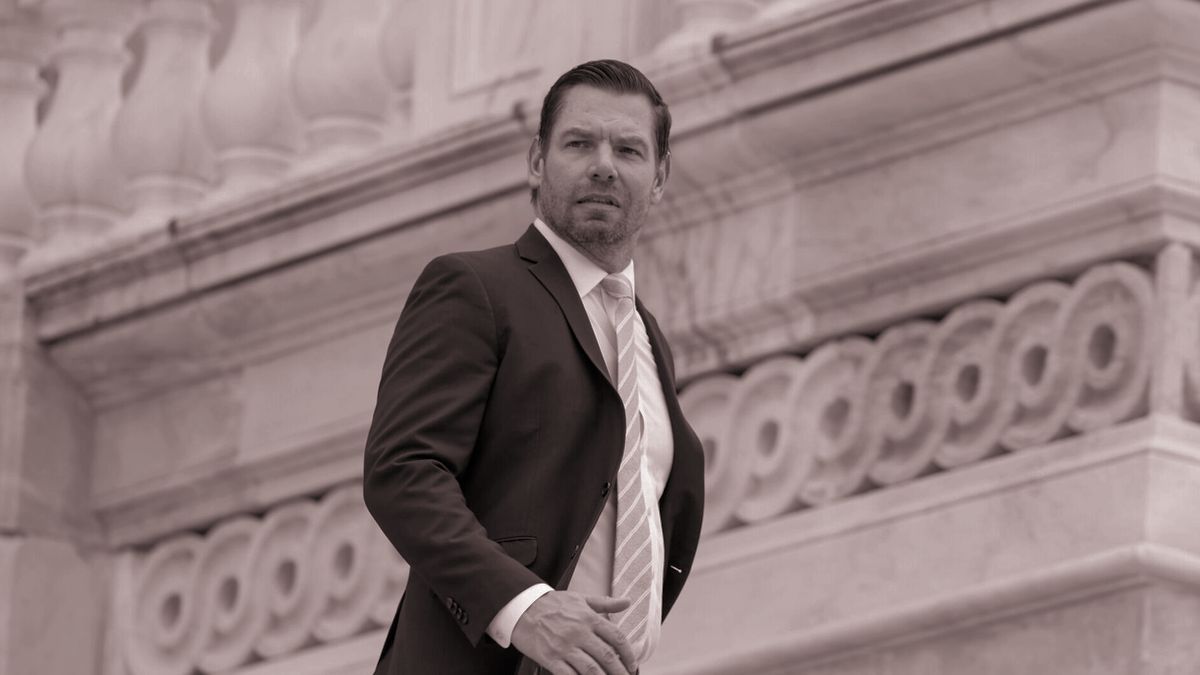
on the implosion of Eric Swalwell, who inhabited a permanent state of ambition during his career in Congress. In California and Washington, people might not have believed the rumors about his behavior with women. But in public, Swalwell was a fame hound with a relentless thirst for publicity—and in my mind, with the benefit of hindsight, his behavior with women and Icarian downfall make a lot of sense.
Plus, Leigh Ann is here with notes on how Sen.
Ruben Gallego, a former Swalwell ally, is navigating the fallout. And Abby calculates Mike Johnson’s congressional margin math if other members follow Swalwell and Rep. Tony Gonzales out the door.
Also mentioned in this issue: Sheila Cherfilus-McCormick, Ace Smith, Sean Clegg, Juan Rodriguez, Jaime Court,
Matt Mahan, Nik Richie, Alex Padilla, Cory Mills, Greg Abbott, Ron DeSantis, Jaime Harrison, Jimmy Gomez, Bryan Lourd, Tom Steyer, Katie Porter, and… Fang Fang.
|
|
|
|

|
Leigh Ann Caldwell
|
|
- Ruben Gallego distances
himself from Swalwell’s “double life”: Reps. Eric Swalwell and Tony Gonzales both officially resigned in disgrace from Congress today, but the fallout is just beginning. Another woman has come forward to accuse Swalwell of sexual assault, alleging that he slipped a drug into her drink, choked her, and raped her in a California hotel in 2018. Swalwell, who has also suspended his campaign for California governor, has denied any sexual misconduct. Meanwhile, Swalwell’s former best friend, Sen.
Ruben Gallego, held an emotional 40-minute news conference today to accuse the former congressman of leading a “double life” and misleading those closest to him—but mostly to deny that he’d had any knowledge of Swalwell’s alleged wrongdoing.
Gallego is a potential 2028 presidential contender, and the press conference was, in many ways, an attempt to put to rest rumors that might spook donors or damage candidates he’s endorsed for 2026, in addition to preserving his own political
ambitions. Reporters, naturally, were skeptical of his denials, given how close the two men were—Gallego even served as co-chair on Swalwell’s short-lived 2020 presidential campaign. Gallego admitted to having heard rumors that his friend was a “flirty, social guy,” but said that Swalwell had denied all of it, including the San Francisco Chronicle report that he’d sexually assaulted a former staffer. (Gallego withdrew his endorsement of his friend’s gubernatorial bid after that.) But
his own judgment, he said, was clouded after two years of attacks by his opponent, Kari Lake, and other Republicans during his own Senate campaign, where his divorce from his first wife was fodder for an onslaught of negative ads.
Gallego was unusually timid but took questions until reporters ran out of them, and choked up at times. “I trusted him with my family,” he said. “And it hurts, the fact that he hurt a lot of people. And it pisses me off that now we all have to
deal with all of his B.S.” In particular, he denounced what he called “lies” from political operatives tying him to misconduct, and said he was not the second man in the video Republicans are circulating online of Swalwell with a woman in what looks like a hotel room. “I don’t even know where it happened,” he said. It’s hard to believe that this will end the chatter about Gallego, but as we know, it takes more than online innuendo to take down a politician—it takes actual, specific allegations
made by real people, and so far, there aren’t any.
|
|
|
|
Instagram Teen Accounts: Automatic protections for teens
Instagram Teen Accounts have built-in protections for who can contact teens and the content they can see. Teen Accounts now have a stricter “Limited content” setting for parents who prefer extra controls.
Nearly 95% of parents say Instagram Teen Accounts help safeguard their teens. We will continue adding features to help protect teens online.
Learn more
|
|
|
|

|
Abby Livingston
|
|
- The tit-for-tat that
isn’t: Swalwell and Gonzales’s twin resignations looked like a neat partisan swap: one Democrat for one Republican, leaving the G.O.P.’s three-seat House margin intact. The departure of the two other members currently in ethical jeopardy—Democrat Sheila Cherfilus-McCormick and Republican Cory Mills, both of Florida—would also seem to neutralize any partisan advantage should they resign or get expelled. But four vacancies mean four potential special
elections, and they don’t hold equal risk for the incumbent party.
The two Democratic seats are safe holds. But the two Republican seats—Gonzales’s in Texas, and Mills’s in Florida—are exactly the kind of marginal turf Democrats have been publicly targeting. That means Texas Gov. Greg Abbott and Florida Gov. Ron DeSantis are in a genuine bind: Either they call special elections and risk losing the seats outright (or at the least, dealing with the
heartache of a potentially expensive competitive race), or sit on the vacancies and functionally shrink a G.O.P. majority that’s already tissue-thin.
|
|
|
|
Even before the misconduct allegations that precipitated his downfall, Eric Swalwell was an
attention-seeking social climber whose professed progressivism may have been his greatest lie of all.
|
|
|
|
Just four days ago, California Rep. Eric Swalwell was a frontrunner in the
race to lead his state as governor. As of today, he’s a disgraced former congressman, having relinquished the seat he’s held for over a decade after a second woman accused him of rape. (He’s denied any sexual misconduct.) It’s a remarkably rapid fall for a politician who spent many years looking around for something bigger and better—and not just higher office.
Last summer, for instance, Swalwell was taking advantage of dial time, but not to solicit donations or test the waters ahead of
his impending jump into the governor’s race. Instead, according to two Democrats I spoke to this week, Swalwell was calling to pitch his A.I. company, Findraiser, a tool that analyzes fundraising data for politicians and campaigns.
Founded by Swalwell and some former staffers, Findraiser has been endorsed by former D.N.C. chairman Jaime Harrison and used by several congressional campaigns, including those of Swalwell’s former close pals Sen.
Ruben Gallego (who just referred to his erstwhile colleague as “a predator”) and Rep. Jimmy Gomez. But Swalwell wasn’t breaking congressional rules by hawking the startup—members of Congress are allowed to own outside companies, as long as they don’t take a salary.
Still, it struck the person on the other end of Swalwell’s call as odd. “I thought, ‘That’s weird. This dude is in Congress but also trying to play entrepreneur around some tacky deal?’” the Democrat told me. “I was like, ‘Let’s talk another time.’”
Last October, I’m told, Swalwell was making more calls, but still not about the governor’s race he’d be joining a month later. This time, Swalwell mentioned a couple of screenplays he was shopping around Los Angeles. (Screenplays about what? I
haven’t been able to confirm, and Swalwell did not respond to a request for comment about them. But Hollywood readers, let me or Belloni know if you’ve seen them!) “He wanted so desperately to be accepted by the Hollywood scene,” the person who talked to Swalwell about the screenplays told me. “Just a total starfucker.”
|
That checks out. For a guy whose congressional district is up in the East Bay, Swalwell sure was down in Los
Angeles a lot, getting himself on camera and raising money from the anti-Trump lib set he cultivated so well over the years. He was a frequent guest on Real Time With Bill Maher—and also at the Maher team’s season wrap parties in West Hollywood. Swalwell also came to town to raise campaign money from all the usual suspects in #Resistance donor world: Robert De Niro, Bryan Lourd, Jane
Fonda, Kathy Griffin, Sean Penn, etcetera.
|
|
|
|
Instagram Teen Accounts: Automatic protections for teens
Instagram Teen Accounts have built-in protections for who can contact teens and the content they can see. Teen Accounts now have a stricter “Limited content” setting for parents who prefer extra controls.
Nearly 95% of parents say Instagram Teen Accounts help safeguard their teens. We will continue adding features to help protect teens online.
Learn more
|
|
|
|
Back in 2024, Swalwell worked to organize Zoom calls in support of Kamala
Harris’s campaign featuring various Hollywood celebs: “Comics for Kamala,” with Ben Stiller and Jason Bateman; “Cooking for Kamala,” with Padma Lakshmi and Tom Colicchio. He would also send the events to me in my Twitter D.M.s, hoping I would promote them for some reason. (Unlike a lot of politicians, Swalwell went around his flacks and kept in
direct touch with reporters on text and email.)
L.A. has always been a wellspring of donor cash for Democratic politicians. But as his fame grew in the Trump years—especially after fronting two impeachment hearings—it seemed like Swalwell liked the party scene a little too much. This week, 4-year-old pictures and videos of Swalwell surfaced on social media with Nik Richie, a media entrepreneur and founder of the salacious 2000s-era gossip
website TheDirty.com. Swalwell is seen sunburned, wearing a robe, grinning from ear to ear on a yacht off St. Tropez packed with attractive younger women. Why? Presumably because Swalwell wanted to party on a yacht—without his wife.
Like many replacement-level politicians in Washington, Swalwell became enamored with his growing fame and the fawning attention that came with it. What else could compel a
little-known four-term congressman to shamelessly run for president in 2020 against a bevy of governors and senators? Or run for governor of the largest state in the nation knowing his own history with women? Or continue to serve in Congress knowing the risk to himself and family? Only the most brazen of politicians would keep riding that lightning.
In recent years, there was simply no guest booking—and no celebrity collab—that Swalwell would turn down. Case in point: In January 2024, the
comedian Matt Friend bumped into Swalwell on the streets of Manhattan. Friend recalled that he immediately launched into his Trump impression for a video, ribbing Swalwell for his onetime relationship with Fang Fang, a suspected Chinese intelligence operative who got close to Swalwell and his campaign operations.
Swalwell is known to bristle at any reference to Fang Fang. But Friend is a rising star, so Swalwell hung onscreen for the entire Trump bit anyway, grinning his way through it. “It’s so insane in hindsight,” Friend told me on Tuesday. “He probably hated it.”
|
When Swalwell entered the California governor’s race last November—on Jimmy Kimmel Live!,
naturally—the water was warm. Bigger names like Kamala Harris and Alex Padilla had passed on the opportunity, leaving the Democratic field full of lesser-known retreads and two onetime frontrunners who had failed to gain traction. One was former congresswoman Katie Porter, who had led in the polls until a pair of videos surfaced showing her berating and harassing staffers, confirming longtime rumors on Capitol Hill about her
temper.
The other was billionaire climate activist Tom Steyer, who was spending tens of millions of dollars on television and streaming ads but failing to catch on with Democratic voters who are skeptical of billionaire business types. Steyer has money to spare: On my drive out to Coachella last week, amid the many promotional billboards for festival headliners, there was a billboard for Steyer riffing on the Sabrina
Carpenter hit “Please Please Please”: “Please Please Please, let’s lower your bills. “TomSteyer.com,” it read. I laughed at the mental image of some Orange County college kid googling Steyer to see if he was a D.J. act in the Sahara Tent that weekend.
Following the Kimmel appearance, Swalwell unleashed a factory load of semi-cringe social media videos, his favorite content genre as a
self-styled next-gen pol. He quickly became the frontrunner in a crowded open primary in which no one, Republican or Democrat, was polling higher than the mid-teens. Swalwell, though, made for an unusual candidate in geographically massive California, where statewide office hopefuls traditionally need relationships and a support network that extend beyond a single congressional district. But Swalwell made up for it with his knack for getting attention. He had a national brand as a Trump fighter
willing to appear on any available screen—which matters more to the emotionally charged Democratic base these days than any newspaper or union endorsement.
When Swalwell joined the field, I shot him a text to catch up. We swapped a few off-the-record notes, and then he said he would get back to me soon with some perspective on his campaign. When he did, it wasn’t with any grand theory about the state of California, or some kind of well-honed strategy against his rivals. Instead, he sent
me a screenshot of odds on Polymarket, which at the time showed him winning the race, ahead of the two frontrunning Republicans, former Fox News talker Steve Hilton and Riverside County Sheriff Chad Bianco.
|
|
|
|
For plenty of California Democrats, Swalwell’s fixation with the prediction markets—he was fond of tweeting
out Kalshi and Polymarket screenshots before his campaign imploded—got at another common complaint about him: What did this guy stand for other than power and ambition? That reputation goes back to his first congressional campaign in 2012, a primary ouster of the aging Bay Area liberal Pete Stark, when Swalwell ran more on turning the generational page than on any sort of policy platform. Swalwell, barely 30, was half a century younger than Stark, and
outhustled him. He’s been in Congress ever since, with few defining accomplishments other than becoming a leader of the anti-Trump MS NOW resistance set.
“There’s always been the empty-suit thing with Eric,” one San Francisco Democratic operative told me Monday. “When he got in the race, it was pretty unsettled, and a lot of the players in California—consultants, unions, business types—they just kind of settled on him because he was an empty slate. The gossip about him and women was
always on the radar, but never came out, so people wondered if it was even true. He became the last non-offensive guy in the mix.” Democrats in Sacramento were skeptical of Porter given questions about her management style and lack of strong relationships in the capital. And the consultant class was very skeptical of Steyer because he was self-funding his campaign, denying many of the usual operatives paychecks and cuts from media buys. But Swalwell didn’t have many deep connections
inside the California political class either.
Swalwell ultimately signed on with Bearstar, the powerful Democratic consulting firm run by Ace Smith, Sean Clegg, and Juan Rodriguez. Bearstar has long had a kind of monopoly power over political campaigns in California, having worked on the campaigns of Kamala Harris and Gavin Newsom over the years, as well as many of the lucrative ballot measures that Californians are so
fond of. Bearstar stood up an independent expenditure group for Swalwell called “Californians for a Fighter” and padded it with a $2 million donation from Uber. Swalwell’s consultants also helped organize labor endorsements from the California Teachers Association and the SEIU, valuable stamps of approval in a state where many Democratic voters look to unions for guidance come Election Day.
Swalwell’s spectacular collapse is also a tough break for Bearstar, which has plenty of critics who
are tired of their outsize influence. “Bearstar couldn’t get their hooks into Porter or Steyer in the same way they had in the past with others, but they got their hooks into Swalwell,” said Jaime Court, the president of Consumer Watchdog. Court is also a fierce critic of Uber’s safety policies and is backing a ballot measure this year that would require Uber to investigate sexual assaults involving drivers in California. He pointed out the irony of the company steering $2 million to
a candidate for governor who is now twice accused of sexual assault. “What a bad bet,” Court told me, somewhat understating things.
The big question about the governor’s race now is who benefits most from Swalwell’s departure. College-educated white #Resistance types might give Porter a second look, and her campaign boasts of internal polling showing as much, even if her fundraising evaporated after those incriminating videos were released last year. San Jose Mayor Matt
Mahan, who is making a play for law-and-order, business-friendly moderates with backing from Silicon Valley honchos, is launching a $14 million ad blitz in the next two weeks to capitalize on Swalwell’s departure. But Steyer has been steadily climbing in the polls, point by point, and no one else has the cash to compete. And time is running out. The primary is on June 2, but early voting starts in three weeks. Swalwell was Steyer’s biggest obstacle, and his downfall may have clinched
the race for the billionaire unless something dramatic unfolds in a campaign that was pretty much drama-free until a few days ago.
|
|
|
|
Join Puck’s chief political columnist, John Heilemann, as he roams the corridors of power and influence in America on this
twice-weekly interview show, taking you beyond the headlines with the people who shape our culture: icons and up-and-comers, incumbents and insurgents, moguls and machers in the overlapping worlds of politics, entertainment, tech, business, sports, media, and beyond. The conversations are rich and revealing, unrehearsed and unexpected… and reliably impolitic. A Puck-Audacy joint, new episodes drop every Wednesday and Friday.
|
|
|
|
Need help? Review our
FAQ page or contact us for assistance. For brand partnerships, email ads@puck.news.
You received this email because you signed up to receive emails from Puck, or as part of your Puck account associated with . To stop receiving this newsletter and/or manage all your email preferences, click here.
|
Puck is published by Heat Media LLC. 107 Greenwich St., New York, NY 10006
|
|
|
|
|







_01KJWSMS03YFF1F7Y1M4D6TQAB.png "Instagram")