Welcome back to The Best & The Brightest. I’m Peter Hamby. I’ll be in D.C. this
weekend for all the various shindigs, including The Puck Penthouse on Saturday—our new pre-WHCD bash, presented by Amazon. We’ll be toasting the fourth estate and all the enterprising journalists and swashbuckling investigators still doing the work, with a little bipartisan comity mixed in for good measure. If you see me, I’ll have another gin and tonic, thanks.
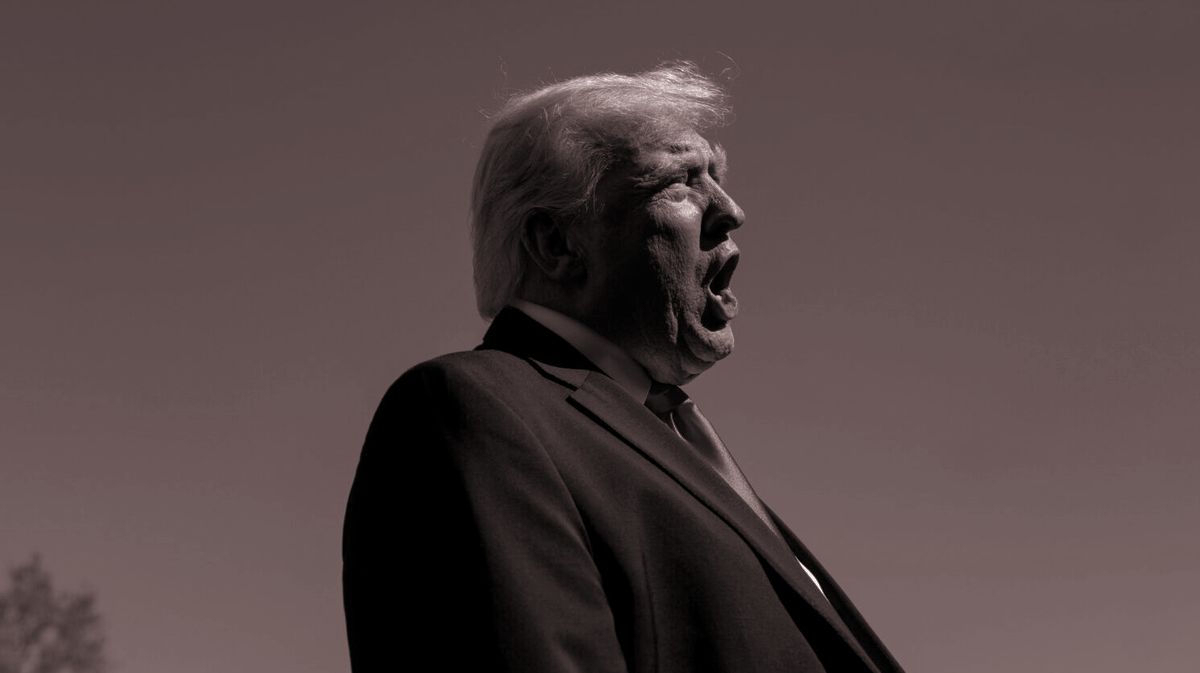
Tonight, I have exclusive new polling for Puck from Echelon Insights on Donald Trump’s war with Iran. Even
after almost two months of conflict and on-again, off-again peace negotiations, voters still have no idea why the U.S. went to war in the first place, nor do they trust Trump to figure out a solution. And as for his war of words with the pope—he’s on the losing side of that, too.
Mentioned in this issue: Joe Kernen, Becky Quick, George W. Bush, Sarah Longwell, Jimmy Carter, Joe
Biden, Donald Trump, Chuck Schumer, J.D. Vance, and… Pope Leo.
|
|
|
|
A MESSAGE FROM OUR SPONSOR
|
When insurers delay approvals or require endless paperwork, patients are left waiting for care they need now.
Addressing harmful corporate insurer practices can help ensure timely access to treatment and protect 24/7 care.
See how.
|
|
|
|

|
Abby Livingston
|
|
Donald Trump’s approval has hit a new low, according to an American Research
Group survey, which shows him at 32 percent—right where George W. Bush was when he left office amid the financial crisis and deteriorating war in Iraq. (The Bulwark’s Sarah Longwell calls this the “Bush line.”) A House Republican operative
I spoke to deployed two other unflattering presidential comparisons: “Donald Trump’s approval ratings are at Carter-esque levels, and Republicans are now confronted with the fact that he’s in worse shape than Joe Biden ever was during his presidency.”
Many political professionals believe this is probably Trump’s floor, given that polls over the years have shown nearly one-third of voters stick with him no matter what. But that’s cold comfort for
Republicans. “With costs continuing to rise and the affordability argument now falling flat 200 days before Election Day, members and operatives are already mentally exhausted,” the House operative said.
|
|
|
|
And now for the main event…
|
|
|
|
Exclusive new polling finds that Americans have no idea what the president is trying to
achieve in Iran—probably because he keeps changing the story, himself. And they’re not thrilled about his war with the pope, either.
|
|
|
|
This morning, just hours before peace talks between the United States and Iran appeared to break down,
Donald Trump called into one of his favorite shows, CNBC’s Squawk Box. A revealing moment arrived about six minutes into the phone interview, when Joe Kernen told the president that “we are kind of tight on time,” and they would need to wrap it up after one more question or two. But Trump being Trump, the president blew past the time limit given to him by the White House, yapping about the war and promising that “a great deal” with Iran
would soon be hashed out in Pakistan. The interview kept going, and going, and going… for a full 37 minutes, concluding more than half an hour after Kernen told him they were about to wrap up.
Of course, Trump loves to yap, especially on the cable news shows he watches. (At one point, he was actually reading back CNBC’s S&P 500 tracker to host Becky Quick live on air while she was pressing him about interest rates.) But the real reason the interview lasted so long was
that there were so many questions—and so many shifting answers from Trump—about the war in Iran.
Trump said that “we have totally won the war,” before saying just a moment later that the war actually isn’t over, and that it’s lasted for a shorter period of time than World War II, Iraq, and Vietnam. “I’m five months,” he said, apparently referring to the length of the Iran “excursion,” which has lasted seven weeks, or five weeks if you subtract the ceasefire. But he projected confidence
nonetheless. “I would have won Vietnam very quickly,” Trump explained.
|
|
|
|
A MESSAGE FROM OUR SPONSOR
|
Prior authorizations and administrative hurdles can slow down critical care, forcing patients to wait while their health
hangs in the balance.
Reforming insurer practices can help reduce delays and keep care moving when it matters most.
Learn more.
|
|
|
|
In the meantime, he said, the price of oil isn’t as high as he thought it would be. The stock market is
humming, thank you very much. He called Chuck Schumer a traitor. He said NATO is useless. He bragged about “regime change” in Tehran, even though that wasn’t supposed to be the goal. Then he said the military is “raring to go” if peace talks with Iran collapse after Wednesday’s diplomatic deadline. “I expect to be bombing,” Trump told Kernen. A few minutes later, news broke that peace talks were paused, with neither side agreeing to basic table stakes. And this afternoon, Trump
posted on Truth Social that he wouldn’t be bombing Iran after all—he would extend both the ceasefire and the military blockade of the Strait of Hormuz.
The whole CNBC session was desultory, defensive, and contradictory—much like Trump’s messaging throughout the entire military campaign. With an equivocator-in-chief holding down the bully pulpit, is it any wonder the American people have no idea why this war is happening?
|
We know that Trump’s Iran adventure is unpopular at this point. Every poll shows it. But I had our polling
partners at Echelon Insights dig a little deeper on the electorate, to get a sense of how voters are processing the news, along with Trump’s scatterbrained rhetoric as he tries to put a bow on yet another messy American war in the Middle East. (You can read the full top-line results here.)
Echelon asked voters a simple, open-ended
question: “What do you think the Trump administration’s primary goal is in its military operations against the Iranian government?” The responses were all over the place. The top category response was to “prevent Iran from getting nuclear weapons.” That is indeed the main rationale that the White House eventually settled on after a confusing start to the bombing campaign in February, when it struggled to explain the purpose of striking Iran. But it was still only a sliver of voters—22
percent—who mentioned this reason. Another 20 percent said the reason for the war is “taking oil.” And 13 percent said the war is just “a show of power.” Other reasons offered: regime change (9 percent), distraction from domestic issues (6 percent), terrorism prevention (6 percent), and helping Israel (5 percent).
The takeaway from that thicket of answers is that there is no consensus view among voters as to what the war is for. In the survey, a majority of voters (56
percent) said that Trump has not clearly communicated why the U.S. is at war with Iran, a number that includes 66 percent of independents and 19 percent of Republicans. Only 35 percent said that Trump has made his reasons clear. There was also a high level of confusion among the swing demos that swept Trump back into office in 2024, when he ran on ending foreign wars and pulling back on U.S. commitments overseas: 59 percent of young voters and 55 percent of Hispanic voters said Trump hasn’t
clearly explained the war’s purpose. And with peace talks faltering—Vice President J.D. Vance delayed his trip to Pakistan for another round of talks on Tuesday—a majority of voters (54 percent) said they do not trust Trump to negotiate an end to the conflict that makes the U.S. safer. Only 41 percent trust Trump to do so.
|
|
|
|
Taken together, it’s an ugly messaging failure for the president and his team at the White House. An
imperfect comparison: After the invasion of Iraq, regardless of whether they supported the war or not, almost 90 percent of American voters agreed that the United States would find weapons of mass destruction there. Dubya and his crew of neocons might have cooked up the evidence, but at least they sold it.
|
How Many
Divisions Has the Pope?
|
Meanwhile, voters are also repulsed by Trump’s war of words with Pope Leo
XIV, who recently said that political leaders must “work for peace and to reject war always.” Trump lashed out at the pope in response, saying he’s “not a fan” of the pontiff and calling him a dangerous liberal. What do voters think? Surprise: Only 24 percent said that Trump criticizing Pope Leo was appropriate, Echelon found, while 67 percent said it wasn’t.
The pope is also far more popular with Americans than Trump is, according to Echelon. Leo boasts a 58 percent favorable
rating with voters, with only 16 percent disapproving. Trump, as usual, is underwater, with Echelon putting his favorable rating at 42 percent.
There is one slice of modestly good news in the poll for the Trump administration, or maybe just the Pentagon: Voters generally believe that the military’s “warfighting” tactics against Iran have been successful, even if the overall strategy remains murky. A plurality (49 percent) said U.S. military operations—clips of which are routinely pushed
out by the administration on social media—have been effective at degrading the Iranian government’s military capabilities. Only 30 percent said the military has not been effective. The American public may not understand why the president went to war, or agree with his tactics, but voters seem to trust that the bombs are doing their job—whatever that is.
|
|
|
|
Join Puck’s chief political columnist, John Heilemann, as he roams the corridors of power and influence in America on this
twice-weekly interview show, taking you beyond the headlines with the people who shape our culture: icons and up-and-comers, incumbents and insurgents, moguls and machers in the overlapping worlds of politics, entertainment, tech, business, sports, media, and beyond. The conversations are rich and revealing, unrehearsed and unexpected… and reliably impolitic. A Puck-Audacy joint, new episodes drop every Wednesday and Friday.
|
|
|
|
Unique and privileged insight into the private conversations taking place inside boardrooms and corner offices up and down Wall
Street, relayed by best-selling author, journalist, and former M&A senior banker William D. Cohan.
|
|
|
|
Need help? Review our
FAQ page or contact us for assistance. For brand partnerships, email ads@puck.news.
You received this email because you signed up to receive emails from Puck, or as part of your Puck account associated with . To stop receiving this newsletter and/or manage all your email preferences, click here.
|
Puck is published by Heat Media LLC. 107 Greenwich St., New York, NY 10006
|
|
|
|
|